Unusual Endangered Animals List: 7 Rare Creatures Fighting for Survival
Earth is home to millions of fascinating animals, but some of its most extraordinary creatures are also among the most threatened. From a tiny marine mammal that lives in a small part of Mexico’s waters to a mysterious forest-dwelling animal that resembles a unicorn, unusual endangered animals reveal just how diverse and fragile our planet’s wildlife can be.
Many of these species have remarkable adaptations that help them survive in specialized environments. Some have evolved unusual body shapes, others possess extraordinary abilities, and a few remain so difficult to observe that scientists still know surprisingly little about their lives. Unfortunately, habitat destruction, illegal hunting, pollution, climate change, and accidental capture in fishing equipment are pushing many of these animals closer to extinction.
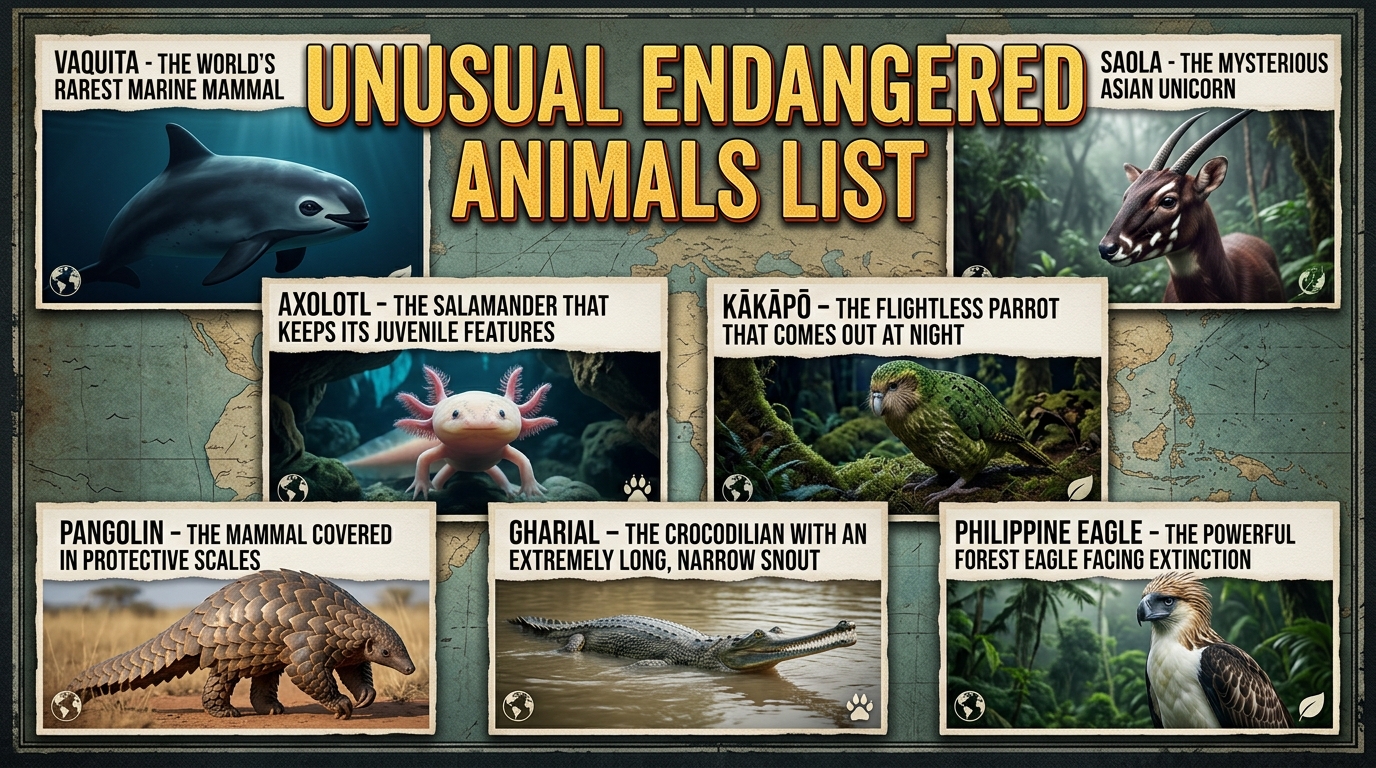
This unusual endangered animals list explores seven rare creatures from different parts of the world. You will learn what makes each animal special, where it lives, what it eats, why its population is declining, and what conservation efforts can do to help protect it.
What Makes an Animal Unusual and Endangered?
An unusual animal may have a rare appearance, distinctive behavior, specialized adaptations, or an exceptionally restricted natural range. An endangered animal, meanwhile, faces a significant risk of extinction in the wild.
The International Union for Conservation of Nature (IUCN) maintains the world’s most widely used global conservation status system. Its Red List classifies species according to their extinction risk. The categories include Vulnerable, Endangered, and Critically Endangered, with Critically Endangered representing an extremely high risk of extinction in the wild.
IUCN
It is important to understand that an unusual appearance does not automatically make an animal endangered. The seven animals below are included because they combine distinctive biological characteristics with serious conservation concerns.

- Vaquita — The World’s Rarest Marine Mammal
Scientific name: Phocoena sinus | Conservation status: Critically Endangered
The vaquita is one of the most unusual and endangered marine animals on Earth. This small porpoise has a rounded head, a compact body, and distinctive dark rings around its eyes and mouth. These markings give it a gentle, almost smiling appearance.
Despite its resemblance to a small dolphin, the vaquita belongs to the porpoise family. It is also one of the rarest marine mammals, with only a handful of individuals believed to remain in the wild.
Where Does the Vaquita Live?
The vaquita lives exclusively in the northern Gulf of California, also known as the Sea of Cortez, in Mexico. Unlike whales and dolphins that travel across vast oceans, this species occupies an exceptionally small geographical range.
Its coastal habitat contains fish, shrimp, and other marine organisms that support the local food web. However, the vaquita’s limited distribution also makes it particularly vulnerable to activities taking place within its habitat.
What Does the Vaquita Eat?
Vaquitas feed on small fish, squid, and crustaceans. They use echolocation, producing sound waves and interpreting returning echoes to help locate prey and navigate underwater.
This ability is especially valuable in water where visibility may be limited. Like other porpoises, vaquitas must surface to breathe air, even though they spend most of their lives underwater.
Why Is the Vaquita Endangered?
The principal threat to the vaquita is accidental entanglement in fishing nets, especially gillnets. These nets are designed to catch fish, but a vaquita that becomes trapped may be unable to reach the surface to breathe.
Illegal fishing for the totoaba, a large fish whose swim bladder is sold on black markets, has intensified the danger. Vaquitas become unintended victims when they encounter nets set to capture totoaba or other commercially valuable species.
NOAA Fisheries identifies eliminating dangerous gillnets from vaquita habitat and stopping illegal fishing as essential measures for the species’ survival.
NOAA Fisheries
Can the Vaquita Be Saved?
Yes, but its recovery depends on immediate and sustained action. Strong enforcement of fishing restrictions, effective alternative fishing equipment, scientific monitoring, and cooperation with local fishing communities are essential.
The vaquita demonstrates that an animal does not need to be hunted directly to face extinction. Sometimes, ordinary human activities can create a threat severe enough to endanger an entire species.
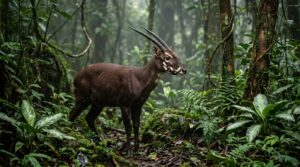
- Saola — The Mysterious Asian Unicorn
Scientific name: Pseudoryx nghetinhensis | Conservation status: Critically Endangered
The saola is one of the world’s most mysterious large land mammals. Sometimes called the Asian unicorn, it has two long, nearly parallel horns and striking white markings on its face.
Despite its antelope-like appearance, the saola is a member of the cattle family. Scientists discovered the species in 1992, making it one of the most remarkable large-mammal discoveries of modern times.
Its rarity is so extreme that much of what researchers know about it comes from camera-trap images, evidence collected in forests, and information shared by local communities.
Where Does the Saola Live?
The saola inhabits the Annamite Mountains along the border of Vietnam and Laos. It is associated with dense, moist forests, often in rugged mountainous terrain.
These forests provide shelter, food, and access to streams. The animal is elusive and difficult to observe, which makes it challenging to determine how many individuals survive and exactly where they live.
What Does the Saola Eat?
Saolas are herbivores. They feed on vegetation, including leaves and other plant material available in their forest habitat.
Their quiet, secretive behavior may help them avoid disturbance, but it also makes scientific research difficult. Researchers still have significant gaps in their understanding of the species’ feeding habits, reproduction, and population dynamics.
Why Is the Saola Endangered?
Hunting is a major threat, particularly through wire snares set to catch other forest animals. A saola can become trapped even when hunters are not specifically targeting it.
Forest degradation and fragmentation create additional pressure by reducing suitable habitat and making isolated populations more vulnerable.
The IUCN’s Saola Working Group has emphasized that urgent searches, stronger protection of the Annamite forests, and the removal of hunting snares are crucial to preventing extinction. The species has not been conclusively detected in the wild since 2013, according to the IUCN’s 2021 statement, highlighting how difficult it is to monitor.
IUCN
What Makes the Saola So Special?
The saola is a reminder that even relatively large mammals can remain almost unknown to science. Its discovery also demonstrates how much biodiversity may still be hidden in remote forests.
Protecting it requires more than preserving trees. Conservation teams must also reduce hunting pressure, involve local communities, and gather reliable evidence about where the animal survives.
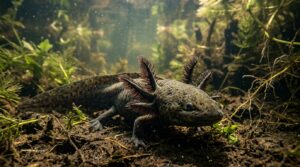
- Axolotl — The Salamander That Keeps Its Juvenile Features
Scientific name: Ambystoma mexicanum | Conservation status: Critically Endangered
The axolotl is an extraordinary amphibian famous for its feathery external gills, broad head, small eyes, and unusual ability to retain juvenile characteristics into adulthood.
Although captive axolotls are often pink or pale because of selective breeding, wild axolotls are generally dark, mottled brown or black. Their distinctive appearance has made them popular in scientific research and aquariums.
However, the animal’s fame in captivity can create a misleading impression: its natural population is severely threatened.
Where Does the Axolotl Live?
The axolotl is native to the freshwater lake and canal systems of the Valley of Mexico. Its remaining natural habitat is particularly associated with the Xochimilco canal network in Mexico City.
Unlike many salamanders that undergo a transformation from aquatic larvae into land-dwelling adults, axolotls normally remain aquatic throughout their lives.
What Does the Axolotl Eat?
Axolotls are carnivorous. They eat small aquatic animals such as worms, insect larvae, small crustaceans, and other suitable prey.
They feed by drawing prey into their mouths, often with a quick suction movement. Their diet and survival depend on a healthy aquatic ecosystem with adequate food and suitable water conditions.
Why Does the Axolotl Look So Different?
One of the axolotl’s most remarkable traits is neoteny, a biological condition in which an animal retains juvenile characteristics after reaching reproductive maturity.
Its external gills remain visible, and it keeps its aquatic lifestyle rather than typically developing into a fully terrestrial salamander. Axolotls can also regenerate certain body structures, including parts of their limbs, which has made them valuable subjects for scientific studies of tissue regeneration.
This regenerative ability is fascinating, but it does not make the animal immune to environmental damage or disease.
Why Is the Axolotl Endangered?
Urban development, water pollution, habitat loss, and introduced fish species have damaged the axolotl’s natural environment. Invasive fish can compete for food or prey on young axolotls.
The IUCN Red List assessment published in 2020 classified the species as Critically Endangered, citing a substantial decline associated with urbanization, polluted waterways, and invasive species.
How Are Scientists Helping the Axolotl?
Conservation initiatives include improving water quality, restoring aquatic vegetation, controlling invasive species, and maintaining suitable refuges within its remaining habitat.
Captive breeding also supports research and may help preserve genetic diversity, but captive populations are not a substitute for healthy wild populations. The long-term goal is to maintain an ecosystem where axolotls can survive and reproduce naturally.
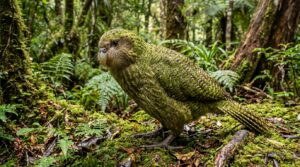
- Kākāpō — The Flightless Parrot That Comes Out at Night
Scientific name: Strigops habroptilus | Conservation status: Critically Endangered
The kākāpō is one of the most unusual parrots in the world. Native to New Zealand, it is large, green, flightless, and primarily nocturnal. Its rounded facial feathers give it an owl-like appearance, while its heavy body and strong legs help it move around the forest floor.
Unlike most parrots, which fly between trees, the kākāpō climbs, walks, and sometimes uses its wings to help balance as it descends.
Where Does the Kākāpō Live?
The kākāpō once occupied a much wider area of New Zealand, including forests and other vegetated habitats. Today, conservation populations live on protected, predator-free islands and in fenced mainland sanctuaries.
These carefully managed environments reduce the threat from introduced predators such as cats, rats, and stoats.
What Does the Kākāpō Eat?
The kākāpō is herbivorous. It feeds on plant material, including leaves, seeds, fruits, and other vegetation.
Its breeding is unusual, too. Breeding activity is strongly influenced by the availability of particular native plants and their fruiting cycles. As a result, successful breeding does not necessarily occur every year.
What Makes the Kākāpō Unique?
The kākāpō is the world’s only flightless parrot and the only parrot known to use a lek-breeding system. In this system, males gather at display sites and produce deep booming calls to attract females.
It is also exceptionally long-lived, with a potential lifespan measured in several decades. These characteristics make the species biologically distinctive but can also complicate its recovery.
Why Is the Kākāpō Endangered?
The arrival of humans and introduced mammalian predators caused dramatic population declines. Because the kākāpō evolved without many of these predators, it lacked effective defenses against them.
Other challenges include low hatching success, disease, and the need to maintain genetic diversity in a small population.
New Zealand’s Department of Conservation identifies the kākāpō as nationally critical and reports that its recovery depends on intensive management, predator-free habitats, and careful breeding support.
Department of Conservation
What Is Being Done to Save the Kākāpō?
Conservation teams monitor individual birds, manage breeding, protect eggs and chicks, and maintain predator-free habitats. Genetic and health monitoring help managers make informed decisions about breeding and population growth.
The kākāpō is an encouraging example of how sustained conservation can help a species recover from an extremely low population. Nevertheless, its future still depends on long-term protection.
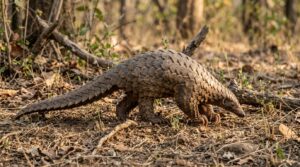
- Pangolin — The Mammal Covered in Protective Scales
Scientific name: Manis crassicaudata (Indian pangolin) | Conservation status: Endangered
The pangolin looks like a combination of an anteater and a walking pinecone. Its body is covered in overlapping scales made of keratin, the same structural protein found in human hair and fingernails.
Despite its armored appearance, the pangolin is a mammal, not a reptile. It is also unusual because it has no teeth and relies on a long, sticky tongue to collect its food.
There are eight recognized pangolin species worldwide, found across parts of Asia and Africa. All eight are threatened with extinction, although their individual IUCN categories differ.
Where Does the Pangolin Live?
The Indian pangolin occurs across parts of the Indian subcontinent, including Pakistan, India, Nepal, and Bangladesh. Depending on the region, it can inhabit dry forests, grasslands, scrublands, and other landscapes where suitable prey and shelter are available.
Other pangolin species inhabit tropical forests, savannas, and woodland environments. Most are solitary and primarily nocturnal, spending much of their active time searching for food.
What Does the Pangolin Eat?
Pangolins mainly eat ants and termites. They use their powerful claws to break into nests and their long tongues to collect insects from narrow spaces.
Their specialized feeding behavior makes them important members of their ecosystems. By consuming large numbers of ants and termites, they influence insect populations and contribute to the natural balance of their habitats.
How Does the Pangolin Protect Itself?
When threatened, a pangolin can curl into a tight ball, placing its vulnerable head and underside inside a protective layer of scales.
This defense may discourage some natural predators, but it offers little protection against a human who can simply pick up the animal. Its natural defense therefore becomes ineffective against the greatest danger it faces.
Why Is the Pangolin Endangered?
Illegal wildlife trafficking is a major threat. Pangolins are hunted for their meat and scales, which enter illegal markets in different parts of the world. Habitat loss and local hunting add further pressure.
The scales have been used in traditional medicinal practices, but their presence in a product does not establish medical effectiveness. Illegal demand has nevertheless contributed to severe pressure on pangolin populations.
How Can Pangolins Be Protected?
Effective conservation requires stronger action against wildlife trafficking, protection of natural habitats, enforcement of wildlife laws, and public education to reduce demand for pangolin products.
Pangolins are a powerful example of why an unusual adaptation does not guarantee survival. Their scales protect them from certain predators, but human exploitation can overcome even this remarkable defense.
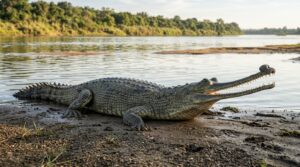
- Gharial — The Crocodilian With an Extremely Long, Narrow Snout
Scientific name: Gavialis gangeticus | Conservation status: Critically Endangered
The gharial is one of the most distinctive reptiles on Earth. At first glance, it resembles a crocodile, but its exceptionally long, slender snout makes it easy to recognize.
Adult males develop a rounded growth at the tip of the snout called a ghara, a feature that gives the species its common name. This structure is associated with courtship and sound production.
Unlike crocodilians with broader snouts adapted for capturing a wider range of prey, the gharial is highly specialized for catching fish.
Where Does the Gharial Live?
The gharial historically occupied river systems across the Indian subcontinent. Today, its surviving populations are concentrated in fragmented stretches of rivers in India and Nepal.
It depends on freshwater rivers with suitable fish populations, relatively undisturbed sandy banks, and exposed areas where it can bask in the sun and lay eggs.
What Does the Gharial Eat?
Fish make up the main part of an adult gharial’s diet. Its long jaws and numerous sharp teeth are well suited to catching slippery prey underwater.
Young gharials may also eat small aquatic invertebrates and other small animals. As they grow, their feeding becomes increasingly specialized toward fish.
Why Is the Gharial Endangered?
Gharials have suffered from the loss and degradation of river habitats. Sand mining, riverbank farming, dams, fishing activities, and disturbance of nesting areas can all affect their survival.
Fishing nets create an additional risk, while changes to river flows can reduce the availability of suitable nesting and basking sites.
The Wildlife Conservation Society and WWF have documented the severe decline of gharials and the challenges they face, including the loss of much of their historical range.
What Is Being Done to Save the Gharial?
Conservation programs include protecting nesting banks, monitoring breeding populations, raising young gharials in managed facilities, and releasing them into suitable river habitats.
However, releasing captive-raised animals is not enough on its own. Rivers must also remain suitable for feeding, nesting, and long-term survival.
The gharial highlights an important conservation principle: protecting a species requires preserving the environmental conditions on which its entire life cycle depends.
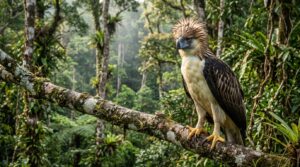
- Philippine Eagle — The Powerful Forest Eagle Facing Extinction
Scientific name: Pithecophaga jefferyi | Conservation status: Critically Endangered
The Philippine eagle is a magnificent bird of prey known for its large body, powerful hooked beak, and striking crest of long feathers. Sometimes called the monkey-eating eagle, it is among the most impressive forest eagles in the world.
Its appearance is dramatic, but its most remarkable feature may be its dependence on extensive tropical forests. This eagle needs large areas in which to hunt, establish territories, and raise its young.
Where Does the Philippine Eagle Live?
The Philippine eagle is endemic to the Philippines, meaning it occurs naturally nowhere else. Its principal habitat is the remaining mature tropical forest on islands such as Mindanao, Luzon, Samar, and Leyte.
These forests provide nesting trees, hunting opportunities, and the connected habitat needed by a large territorial predator.
What Does the Philippine Eagle Eat?
The Philippine eagle is carnivorous. Its prey can include flying lemurs, monkeys, birds, snakes, and other small to medium-sized animals, depending on the habitat and available food.
Its strong feet, sharp talons, and hooked beak help it capture and process prey. As a major forest predator, it also plays a role in the ecological relationships that keep tropical forest communities functioning.
What Makes the Philippine Eagle Unusual?
The eagle’s impressive size, shaggy crest, and specialized forest-hunting behavior distinguish it from many other birds of prey.
It also reproduces slowly. Breeding pairs invest considerable time and energy in raising offspring, so the loss of adults or breeding habitat can have a lasting impact on population recovery.
This slow reproductive pace makes long-term protection particularly important.
Why Is the Philippine Eagle Endangered?
Deforestation is a major threat because the eagle depends on large areas of mature forest. Logging, agricultural expansion, mining, and infrastructure development can destroy or fragment its habitat.
Hunting and accidental killing also create risks. When forest patches become isolated, individual eagles may have fewer opportunities to find mates and establish viable territories.
How Can the Philippine Eagle Be Saved?
Protecting remaining forests, restoring degraded habitat, preventing illegal hunting, and supporting local conservation communities are essential steps.
Conservation organizations also work on captive breeding, research, and public education. Because the eagle needs extensive forest habitat, protecting the wider ecosystem benefits many other species at the same time.
The Philippine eagle illustrates how the decline of a single remarkable animal can signal broader environmental problems within an entire region.
Quick Comparison: Seven Unusual Endangered Animals
| Animal | Natural range | Most distinctive feature | Major threat |
| Vaquita | Northern Gulf of California, Mexico | Dark rings around its eyes and mouth | Entanglement in gillnets |
| Saola | Vietnam and Laos | Two parallel, nearly straight horns | Hunting snares |
| Axolotl | Valley of Mexico | External gills and regenerative abilities | Water pollution and habitat degradation |
| Kākāpō | New Zealand | Flightless, nocturnal parrot | Introduced predators |
| Pangolin | Parts of Asia and Africa | Protective keratin scales | Illegal wildlife trafficking |
| Gharial | Rivers of India and Nepal | Extremely long, narrow snout | River habitat degradation |
| Philippine eagle | Philippines | Large crest and powerful build | Deforestation and hunting |
Conservation status refers to the global IUCN classification where specified. The Indian pangolin is used as the representative pangolin species in this list; conservation categories differ among pangolin species.
Why Are Unusual Endangered Animals Disappearing?
Although these seven animals live in very different environments, several underlying threats are shared among them.
- Habitat Loss and Fragmentation
Forests are cleared, wetlands are drained, and rivers are altered to make space for agriculture, buildings, roads, and other development.
When a habitat shrinks, animals may lose access to food, shelter, nesting sites, and potential mates. Fragmentation can also isolate populations, making it harder for them to maintain healthy genetic diversity.
The saola and Philippine eagle are particularly vulnerable to changes in forest habitats, while the axolotl depends on healthy freshwater environments.
- Illegal Hunting and Wildlife Trade
Some animals are captured or killed for their body parts, meat, or value in the illegal pet trade. Pangolins are especially affected by trafficking, while hunting snares pose a serious threat to the saola.
Even when hunting is directed at another species, indiscriminate traps can kill animals that were never intended targets.
- Pollution and Changes to Freshwater Ecosystems
Chemical pollution, untreated wastewater, sediment, and other contaminants can damage aquatic ecosystems.
For animals such as axolotls and gharials, healthy water systems are essential for feeding, breeding, and survival. Protecting the species therefore requires improving the quality of the entire habitat.
- Accidental Capture in Fishing Equipment
Fishing nets can unintentionally catch animals that are not the intended target. This is known as bycatch.
For the vaquita, entanglement in gillnets is the principal known cause of mortality. Reducing dangerous fishing practices within its habitat is therefore central to its survival.
- Slow Reproduction and Small Populations
Some endangered animals reproduce slowly, raise only a few offspring, or require specific environmental conditions to breed successfully.
When populations become extremely small, the loss of even a few individuals can have a major effect. Small populations can also face inbreeding and reduced genetic diversity, increasing the difficulty of long-term recovery.
How Can We Help Protect These Rare Animals?
Protecting endangered wildlife requires action from governments, conservation organizations, businesses, local communities, and individuals.
Here are several practical ways people can contribute.
- Support credible conservation organizations. Choose organizations that explain their work, use reliable evidence, and report how donations support wildlife protection.
- Avoid illegal wildlife products. Do not purchase products made from protected animals, including pangolin scales or other illegally traded wildlife parts.
- Choose responsible seafood. Where possible, support fisheries that use methods designed to reduce accidental capture of threatened marine animals.
- Protect natural habitats. Support forest restoration, wetland conservation, river protection, and sustainable land management.
- Promote wildlife education. Share accurate information about unusual endangered animals and the threats they face.
- Support stronger environmental policies. Effective enforcement of wildlife laws and habitat protections can make a substantial difference.
- Respect wild animals. Never disturb nests, approach vulnerable wildlife unnecessarily, or buy wild-caught animals from illegal traders.
Individual actions alone cannot solve every conservation problem. However, informed choices and public support can help strengthen larger efforts to protect endangered species.
Frequently Asked Questions
What is the rarest animal on this list?
The vaquita is among the rarest marine mammals in the world. Recent assessments have indicated that only a handful of individuals may remain. Its extremely small population makes the prevention of deaths in fishing nets especially urgent.
The saola is another exceptionally rare animal, but its secretive behavior and limited observations make its surviving population difficult to estimate reliably.
Which endangered animal has the most unusual appearance?
That depends on personal opinion. The axolotl is famous for its external gills and juvenile-like appearance, the pangolin resembles a scaled mammal, and the saola has unusual parallel horns.
The gharial’s extremely narrow snout and the kākāpō’s owl-like face also make them particularly distinctive.
Are all seven animals critically endangered?
No. The vaquita, saola, axolotl, kākāpō, gharial, and Philippine eagle are classified as Critically Endangered in the conservation assessments referenced here. The Indian pangolin is classified as Endangered.
Conservation classifications can change when new population information becomes available or when threats improve or worsen. For the most current assessment of any species, consult the IUCN Red List.
Can endangered animals recover from very small populations?
Yes, recovery is possible, but it is not guaranteed. Successful conservation usually requires reducing the threats responsible for the decline, protecting habitat, improving breeding success, and monitoring population health.
The kākāpō is an example of a species that has benefited from intensive management. For other animals, such as the vaquita, preventing additional deaths remains an immediate priority.
Why should we protect unusual endangered animals?
Every species represents a unique part of Earth’s biological diversity. Some contribute to food webs, others influence insect populations, and many depend on habitats that also support numerous other plants and animals.
Their loss would remove irreplaceable evolutionary history and could weaken the ecosystems in which they live. Protecting them is therefore about preserving not just individual animals, but the natural systems that sustain life.
What is the difference between endangered and critically endangered?
Under the IUCN Red List system, Endangered means a species faces a very high risk of extinction in the wild. Critically Endangered means it faces an extremely high risk.
Both categories indicate serious conservation concern, but Critically Endangered represents the more urgent level of extinction risk.
Conclusion
The seven animals in this unusual endangered animals list demonstrate the extraordinary variety of life on Earth. The vaquita’s distinctive face, the saola’s mysterious existence, the axolotl’s regenerative abilities, the kākāpō’s flightless lifestyle, the pangolin’s protective scales, the gharial’s specialized jaws, and the Philippine eagle’s impressive size all reveal different ways animals have adapted to their environments.
Yet these adaptations cannot protect them from every human-caused threat. Habitat destruction, illegal hunting, pollution, and unsafe fishing practices continue to place many unique species at risk.
The encouraging news is that conservation can make a difference. Protecting natural habitats, enforcing wildlife laws, supporting scientific research, and involving local communities can help threatened populations survive and recover.
Every unusual animal that survives extinction preserves a unique piece of our planet’s natural heritage. Protecting these creatures today helps ensure that future generations can continue to discover, study, and appreciate the extraordinary diversity of wildlife.