

Rat Speed vs. Human Running: The Ultimate Comparative Analysis
The speed dynamic between humans and rats is one of the most intriguing natural comparisons. While humans dominate long-distance endurance running, rats possess rapid acceleration, high agility, and impressive relative speed.
Can You Outrun a Rat? The Raw Speed Breakdown

Absolute Speed vs. Relative Speed
When measuring speed in absolute terms (miles per hour or kilometers per hour), an average adult human easily outpaces a rat.
- Average Human Sprint: 12 to 15 mph (19 to 24 km/h)
- Elite Human Sprint (Usain Bolt Peak): 27.78 mph (44.7 km/h)
- Average Rat Speed: 6 to 8 mph (9.5 to 13 km/h)
- Peak Rat Burst (Black Rat/Distressed): Up to 10 to 12 mph (16 to 19 km/h)
However, the comparison changes dramatically when evaluated through body lengths per second (BL/s):
- An average human sprinting at 15 mph moves roughly 3 to 4 body lengths per second.
- A rat sprinting at 8 mph moves approximately 8 to 11 body lengths per second.
In terms of scale, a rat accelerates and covers distance relative to its size far faster than a human.
Biomechanics — How Rats and Humans Generate Speed
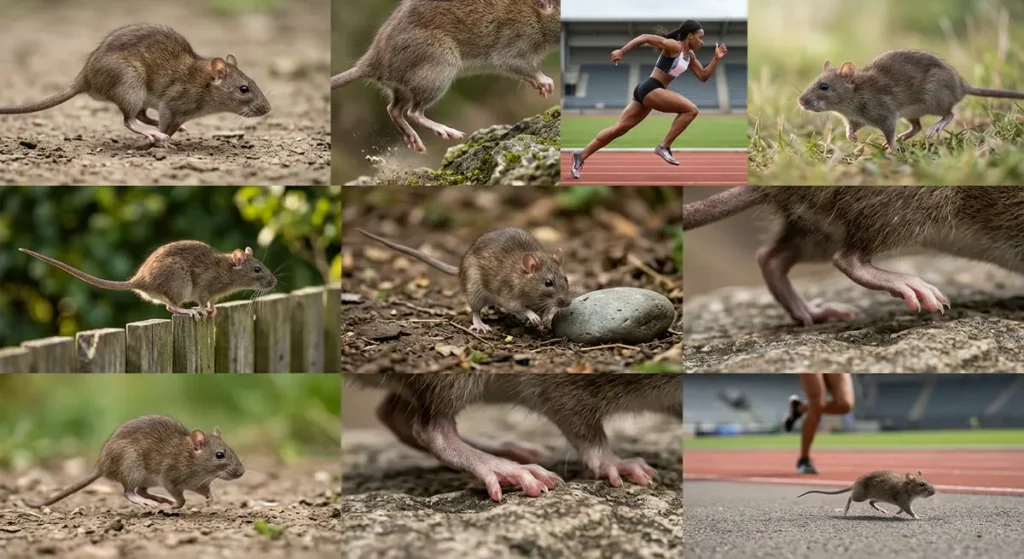
The difference in speed between rats and humans comes down to physical mechanics and anatomical adaptations.
| Attribute | Human Mechanics | Rat Mechanics |
| Locomotion Type | Bipedal (Two legs) | Quadrupedal (Four legs) |
| Posture | Plantigrade (Flat feet) | Digitigrade-like movement during sprints |
| Spine Flexibility | Rigid upright support | Highly flexible arching spine |
| Power Source | Glutes, quads, and calves | Muscular hind legs acting like springs |
Quadrupedal Launch vs. Bipedal Stride
- Flexibility & Springs: A rat uses its flexible spine and spring-loaded hind legs to push off the ground, maximizing force with minimal weight penalty.
- Center of Gravity: A low center of gravity gives rats high stability during high-speed turns.
- Balance: A rat’s tail acts as a counterweight, preserving momentum across narrow or uneven surfaces.
Acceleration, Agility, and Reaction Time
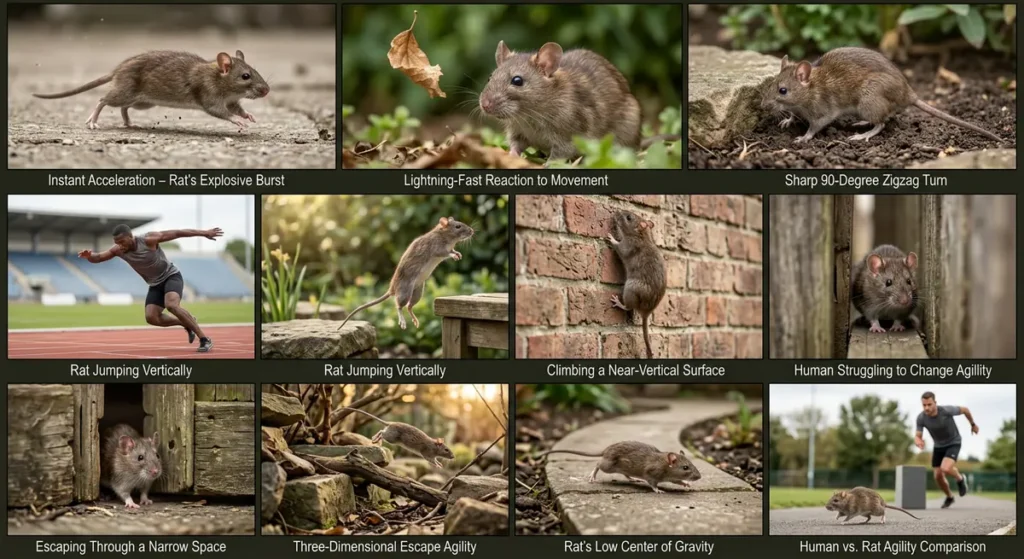
In real-world encounters, top speed matters less than acceleration and change of direction.
[Reaction Time] ➔ [Instant Burst] ➔ [Sharp Zig-Zag] ➔ [Vertical Escape]
(Human: ~200ms) (Flexed Spine) (Low Gravity) (3-4 ft Jump)
Why Rats Are Hard to Catch
- Instant Acceleration: Rats hit top speed within a fraction of a second.
- Reaction Speed: A rat’s neural pathway is significantly shorter, allowing faster reaction times to sudden movements.
- Agility and Omnidirectional Mobility: While humans require radius room to turn at high speed, rats can execute sharp 90-degree pivots without dropping velocity.
- Vertical Mobility: Rats can jump up to 3 to 4 feet vertically and climb near-vertical textured surfaces, adding a 3D element to their escape routes.
Sprinting vs. Endurance — Sprint Specialists vs. Marathoners

Humans and rats utilize fundamentally different energy systems for movement.
The Human Advantage: Thermoregulation & Endurance
Humans are among the best endurance runners on Earth due to:
- Sweat Glands: Efficient cooling allows humans to run prolonged distances without overheating.
- Aerobic Capacity: High pulmonary efficiency built for long distances.
The Rat Limitation: Short Anaerobic Bursts
Rats rely heavily on anaerobic energy bursts:
- Short Distances: Built for quick dashes between cover (typically under 30–50 feet).
- Overheating: Lacking sweat glands, rats dissipate heat through their tail and paws, making sustained long-distance running dangerous for them.
- Stamina: In a sustained chase over 100 yards, a human’s stamina easily overtakes a rat’s initial burst.
Environmental Factors — Surface, Obstacles, and Urban Terrain

Running speed varies based on the environment.
TERRAIN ADVANTAGE BREAKDOWN
Open Track / Flat Ground —> Human Advantage (Maximum stride length)
Tight Spaces / Indoors —> Rat Advantage (Small size & low profile)
Rough / Uneven Terrain —> Rat Advantage (4-point contact stability)
Terrain Performance Matrix
- Flat Asphalt / Open Field: Humans maximize stride length to achieve top speed, leaving rats behind over distance.
- Cluttered Indoors / Debris: Rats maintain high speeds through narrow gaps, under furniture, and around obstacles where humans must slow down or stop.
- Pipes, Ropes, and Beams: Rats maintain speed on narrow structures using their tail for balance.
Species Variations — Brown Rats vs. Roof Rats vs. Human Athletes
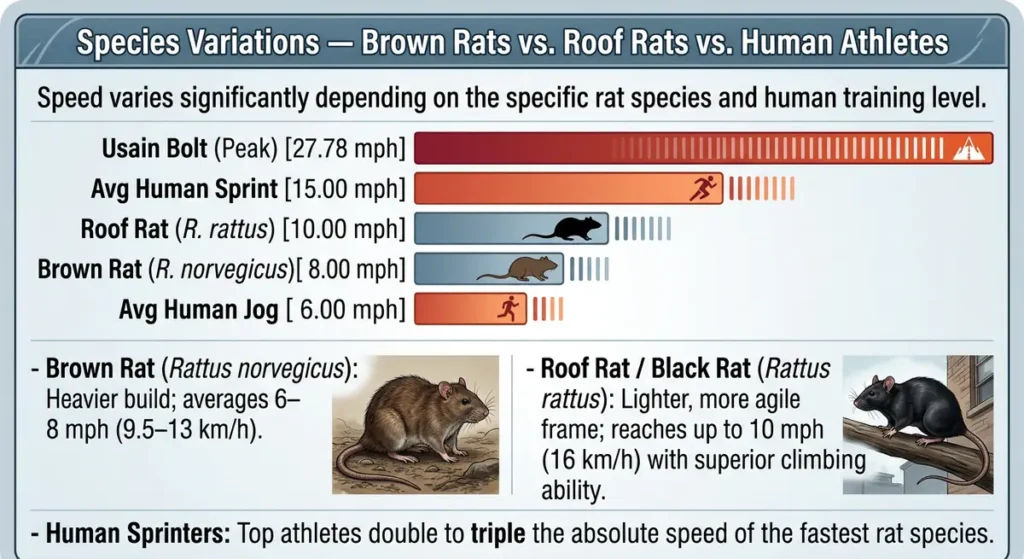
Speed varies significantly depending on the specific rat species and human training level.
Usain Bolt (Peak) [27.78 mph] ||||||||||||||||||||||||||||
Avg Human Sprint [15.00 mph] |||||||||||||||||
Roof Rat (R. rattus) [10.00 mph] ||||||||||
Brown Rat (R. norvegicus)[ 8.00 mph] ||||||||
Avg Human Jog [ 6.00 mph] ||||||
- Brown Rat (Rattus norvegicus): Heavier build; averages 6–8 mph (9.5–13 km/h).
- Roof Rat / Black Rat (Rattus rattus): Lighter, more agile frame; reaches up to 10 mph (16 km/h) with superior climbing ability.
- Human Sprinters: Top athletes double to triple the absolute speed of the fastest rat species.
Evolutionary Purpose — Why Each Species Evolved Its Speed

Movement mechanics reflect evolutionary pressures:
Why Rats Evolved Burst Speed
- Predator Avoidance: Owls, cats, snakes, and hawks target rats. Survival depends on reaching cover instantly rather than outrunning predators over distance.
- Foraging Habits: Quick dashes across open areas reduce exposure time.
Why Humans Evolved Endurance Speed
- Persistence Hunting: Early hominids tracked prey over long distances, driving animals to exhaustion.
- Bipedal Efficiency: Walking and running on two legs conserves energy over vast distances.
Key Takeaway
In a straight line over an open distance, a human will always outrun a rat. However, in tight spaces requiring rapid acceleration, sharp turns, and quick reaction times, the rat’s relative agility makes it far faster in short bursts.