7 Endangered Fish: Rare and Incredible Underwater Creatures That Need Our Protection
The underwater world is full of fascinating creatures. Some fish have enormous bodies, others have unusual shapes, beautiful colors, or extraordinary abilities that help them survive in rivers and oceans. However, many of these remarkable creatures are now facing the threat of extinction.
From a tiny fish that uses its fins like hands to walk across the ocean floor to a giant freshwater catfish weighing hundreds of kilograms, endangered fish come in many surprising forms.
Unfortunately, overfishing, water pollution, habitat destruction, climate change, and the construction of dams are putting many fish populations at risk.
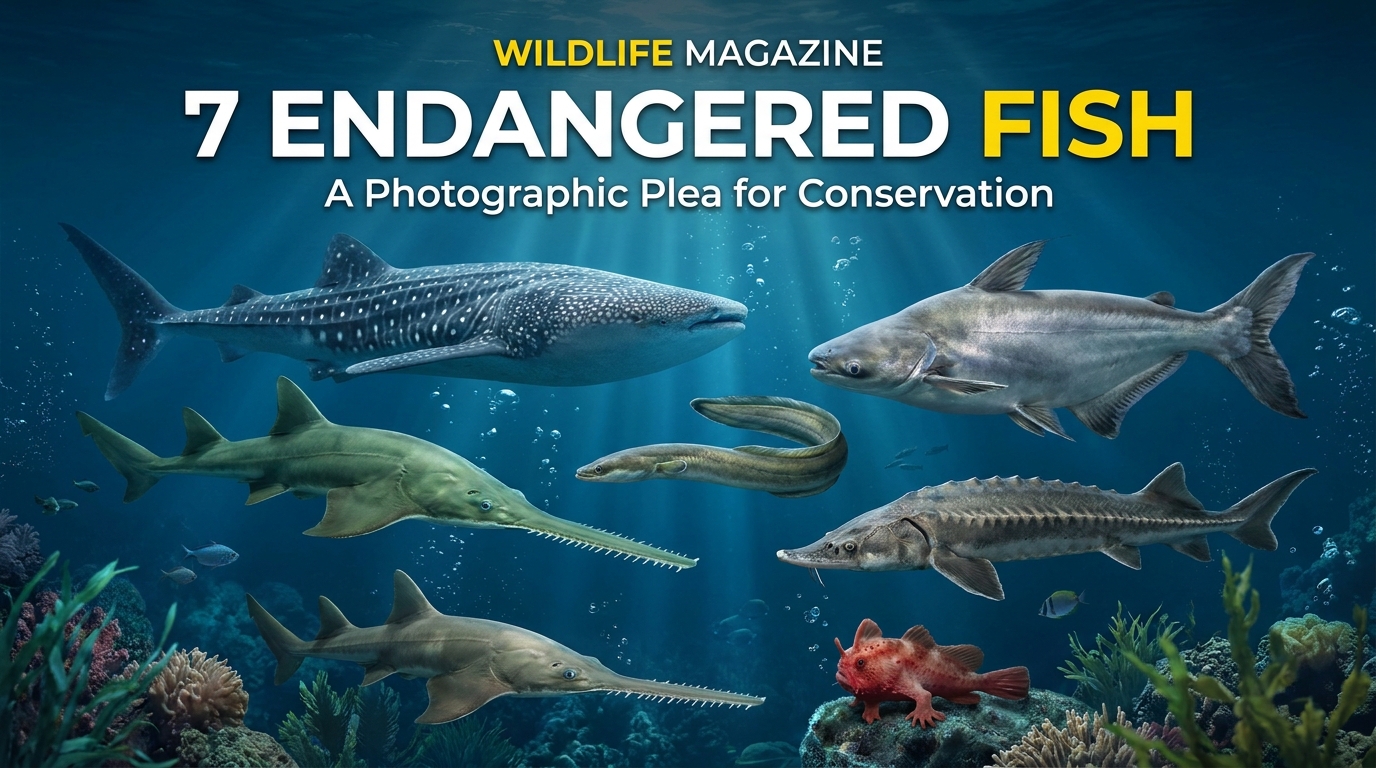
In this article, we will explore seven endangered fish species, discover their unusual characteristics, learn where they live, and understand why they need protection.
List of 7 Endangered Fish We Will Explore
Here are the seven fascinating fish featured in this article:
- Red Handfish – The tiny fish that walks using hand-like fins.
- Mekong Giant Catfish – The enormous freshwater fish of Southeast Asia.
- European Eel – The mysterious fish with an extraordinary migration journey.
- Green Sawfish – The giant fish with a long, toothed saw-like snout.
- Chinese Sturgeon – The ancient-looking fish with protective body plates.
- Whale Shark – The world’s largest fish and gentle ocean giant.
- Smalltooth Sawfish – The rare marine fish with a remarkable toothed snout.
Conservation note: The species in this article have different conservation classifications. Some are Critically Endangered, while others are Endangered. Categories refer to global assessments unless otherwise specified.
Red Handfish – The Tiny Fish That Walks on Its Hands
Scientific Name: Thymichthys politus
Native Location: Tasmania, Australia
Conservation Status: Critically Endangered (Australian national listing)
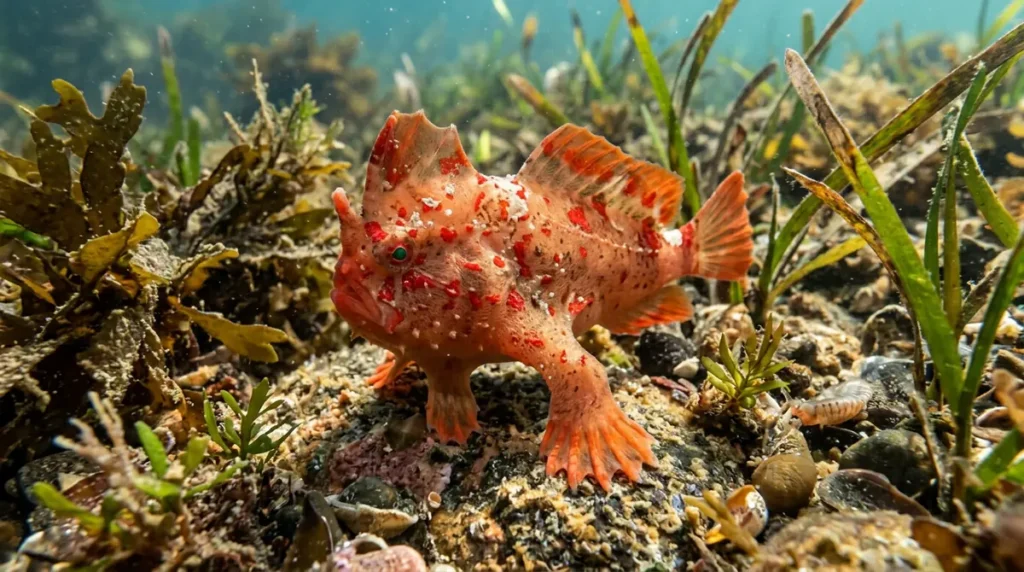
The Red Handfish is one of the strangest fish found in the ocean. Unlike most fish that swim using their tails and fins, this tiny creature uses its specially modified fins to walk across the seabed.
It is a small marine fish that usually measures less than 10 centimetres long. Its unusual appearance and limited habitat make it one of the most fascinating endangered fish in the world.
What Makes the Red Handfish So Unusual?
The most interesting feature of the Red Handfish is its hand-shaped pectoral fins.
These fins resemble tiny hands and help the fish move along the ocean floor instead of swimming continuously through the water.
Its body can display different shades of red, orange, and pale tan, sometimes with dark spots and markings.
Another unusual characteristic is that it does not have a swim bladder, the gas-filled organ that helps many fish control their position in the water.
Instead of travelling long distances, the Red Handfish usually stays within a small area of reef habitat.
Why Is the Red Handfish Endangered?
The Red Handfish lives in extremely limited areas around Tasmania, making it particularly vulnerable to environmental changes.
One major threat is habitat degradation. It depends on healthy seaweed and seagrass environments for shelter and reproduction.
Overgrazing by sea urchins can destroy important seaweed habitats. Pollution, warmer ocean temperatures, and human disturbance also threaten its survival.
Conservation teams are working to protect its remaining habitat, improve breeding opportunities, and support captive breeding programmes.
Interesting Fact: The Red Handfish uses its hand-like fins to walk along the seabed, making it look almost as if it has tiny legs.
Mekong Giant Catfish – The Enormous Freshwater Fish
Scientific Name: Pangasianodon gigas
Native Location: Mekong River Basin, Southeast Asia
Conservation Status: Critically Endangered
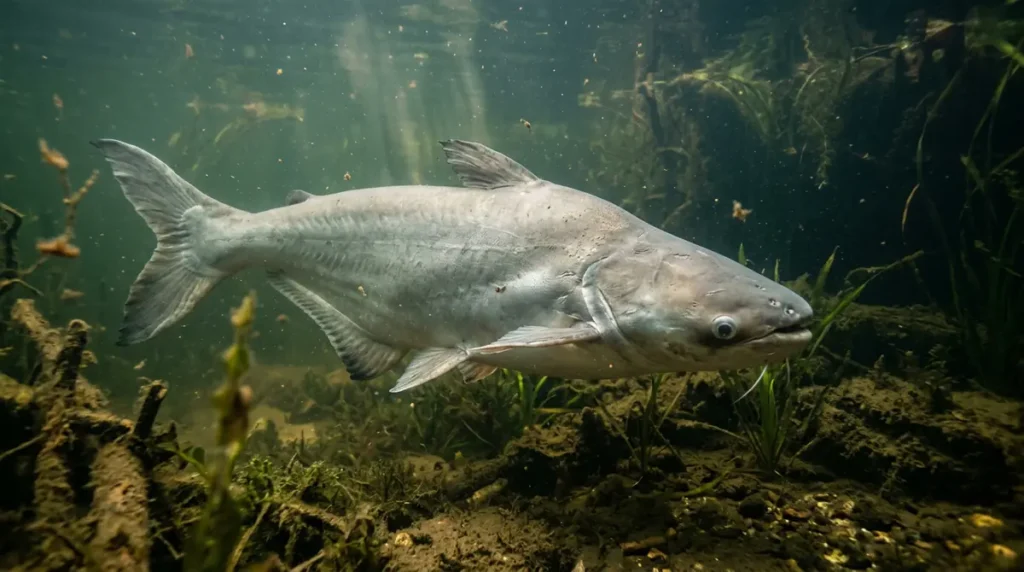
Imagine a freshwater fish that can grow longer than an average adult human and weigh as much as several people combined. That is the remarkable Mekong Giant Catfish.
This enormous fish is one of the largest freshwater fish species in the world. It is naturally found in the Mekong River system, which flows through several Southeast Asian countries.
Despite its impressive size, this gentle giant is becoming increasingly rare.
What Makes the Mekong Giant Catfish So Unusual?
The Mekong Giant Catfish is famous for its enormous body. It can reach approximately three metres in length and weigh up to 300 kilograms.
Unlike many other catfish, adult Mekong Giant Catfish have a relatively smooth appearance and lack the prominent whiskers commonly associated with catfish.
Another interesting characteristic is its feeding behavior. Adults are primarily herbivorous, meaning they feed mainly on plant material and algae.
This makes the species different from many large predatory freshwater fish.
Why Is the Mekong Giant Catfish Endangered?
Overfishing has played a major role in the decline of this species.
Because of its enormous size, it has historically been targeted by fishermen. However, its slow reproduction makes population recovery difficult.
The construction of dams is another serious threat. Mekong Giant Catfish need to migrate along the river to complete important stages of their life cycle.
When dams block these migration routes, fish may struggle to reach suitable spawning areas.
Habitat destruction and changes in river conditions also threaten the species.
Conservation programmes now focus on protecting migration routes, monitoring populations, and preventing illegal fishing.
Interesting Fact: The Mekong Giant Catfish can grow to approximately three metres long and weigh up to 300 kilograms, making it one of the largest freshwater fish on Earth.
European Eel – The Mysterious Fish With an Incredible Migration Journey
Scientific Name: Anguilla anguilla
Native Location: European rivers and coastal waters
Conservation Status: Critically Endangered
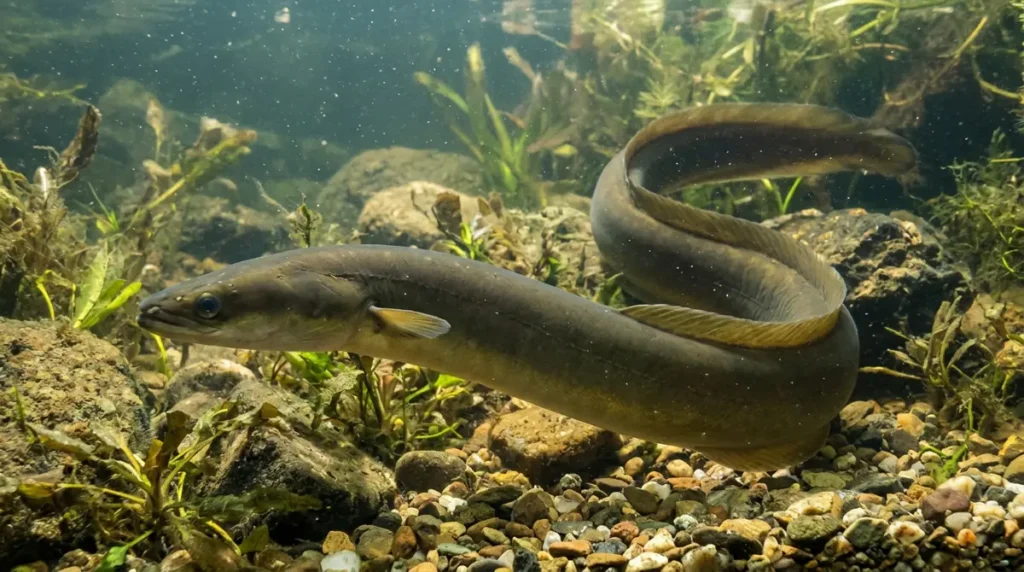
The European Eel is one of the most mysterious fish in the aquatic world. Its long, snake-like body makes it look very different from most familiar fish.
However, its most fascinating characteristic is its extraordinary migration journey.
Unlike fish that spend their entire lives in one river or ocean, European Eels travel between freshwater habitats and the open sea during different stages of their lives.
What Makes the European Eel So Unusual?
The European Eel has an elongated body covered with tiny scales, giving it a smooth, slippery appearance.
Its life cycle is especially unusual.
It begins life in the Sargasso Sea, a region of the Atlantic Ocean. Tiny larvae travel across the ocean toward European and North African coastlines.
As they develop, they transform into transparent glass eels and later into yellow eels.
They spend years growing in rivers, lakes, and coastal waters before becoming silver eels.
When mature, they travel thousands of kilometres back toward the Sargasso Sea to reproduce.
Even today, many details of their migration and reproduction remain fascinating subjects of scientific research.
Why Is the European Eel Endangered?
European Eels face several serious threats.
Overfishing affects different stages of their life cycle, including young glass eels and mature adults.
Dams and other river barriers make it difficult for them to migrate between freshwater and marine habitats.
Water pollution, habitat destruction, parasites, and climate-related changes also contribute to their decline.
The European Eel has been classified as Critically Endangered on the IUCN Red List.
Conservation efforts include improving river connections, reducing fishing pressure, and protecting important migration routes.
Interesting Fact: European Eels travel thousands of kilometres to return to the Sargasso Sea, where they reproduce and complete their extraordinary life cycle.
Green Sawfish – The Fish With a Giant Natural Saw
Scientific Name: Pristis zijsron
Native Location: Indo-West Pacific region
Conservation Status: Critically Endangered
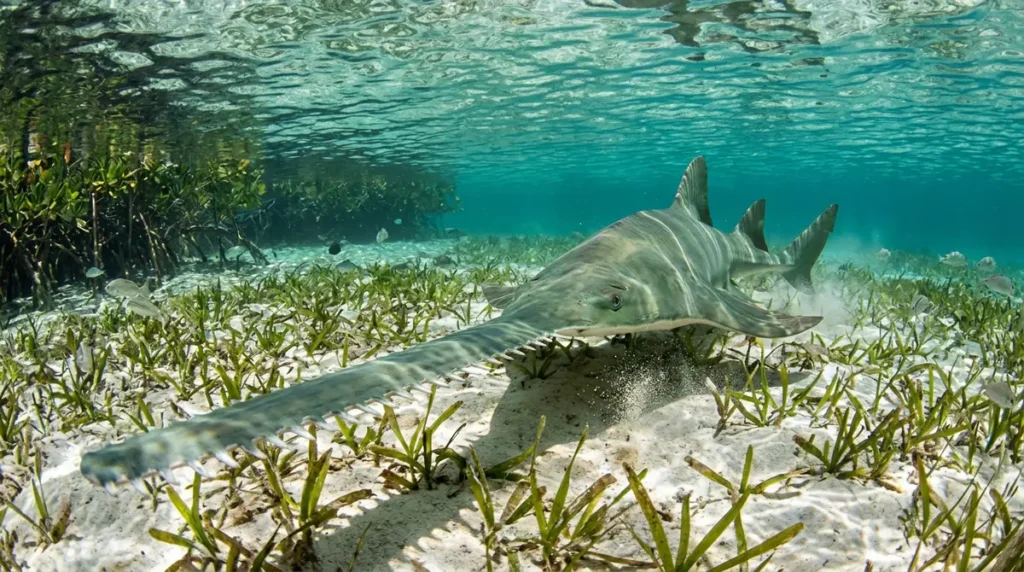
The Green Sawfish is one of the most unusual-looking fish in the ocean. Its long, narrow snout is lined with sharp teeth-like structures, giving it the appearance of a giant underwater saw.
Although it looks frightening, this remarkable creature is not a sea monster. It is a type of ray and belongs to a group of fish called sawfishes.
What Makes the Green Sawfish So Unusual?
Its most recognizable feature is its long, toothed snout, known as a rostrum.
This specialized structure helps the fish detect and capture prey in the water.
The Green Sawfish has a flattened body, broad pectoral fins, and a long tail. Its body is generally greenish or grey-brown, helping it blend into its natural environment.
Some individuals can grow beyond seven metres in length, making them among the largest sawfish species.
Young Green Sawfish often use shallow coastal waters, while adults can move into deeper marine environments.
Why Is the Green Sawfish Endangered?
One of its biggest threats is accidental capture in fishing equipment.
Its long toothed snout can become entangled in fishing nets, making it difficult for the animal to escape.
Coastal habitat destruction also creates problems because young sawfish depend on shallow waters for shelter and development.
Overfishing, coastal development, and the loss of mangrove and seagrass habitats have contributed to population declines.
International conservation measures now protect sawfish from commercial trade, but continued habitat protection and fishing controls are essential.
Interesting Fact: The Green Sawfish can grow longer than seven metres, and its unusual saw-like snout makes it one of the most recognizable fish in the ocean.
Chinese Sturgeon – The Ancient-Looking Fish of the Yangtze River
Scientific Name: Acipenser sinensis
Native Location: Yangtze River and nearby coastal waters of China
Conservation Status: Critically Endangered
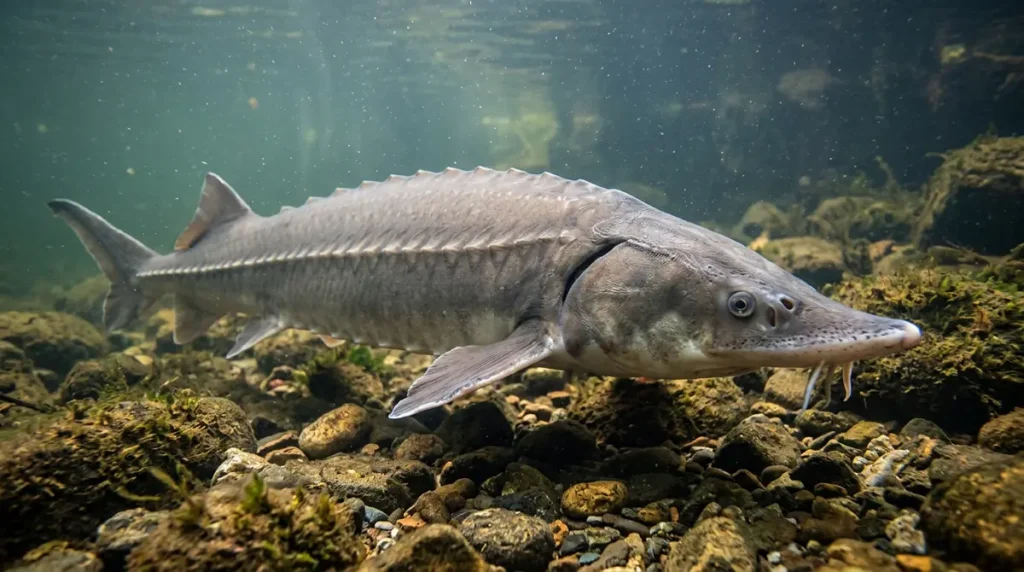
The Chinese Sturgeon is an extraordinary fish with an appearance that seems to belong to another age. Its large body, pointed snout, and rows of protective bony plates make it look quite different from ordinary fish.
Sturgeons are an ancient group of fishes that have existed for millions of years.
The Chinese Sturgeon is particularly important because of its connection to the Yangtze River ecosystem.
What Makes the Chinese Sturgeon So Unusual?
One of its most interesting characteristics is its armored appearance.
Instead of having ordinary overlapping scales covering its body, the Chinese Sturgeon has several rows of hard, protective bony plates called scutes.
It also has a pointed snout and four small sensory barbels near its mouth. These help it locate food along the riverbed.
The Chinese Sturgeon is a migratory fish. It spends much of its life in marine waters but returns to freshwater rivers to reproduce.
It can grow to approximately five metres in length, making it one of the largest sturgeon species.
Why Is the Chinese Sturgeon Endangered?
The Chinese Sturgeon has experienced a dramatic population decline.
One of the biggest problems is the construction of dams along the Yangtze River.
These structures interfere with migration routes and reduce the natural spawning areas available to the fish.
Water pollution, habitat changes, and illegal fishing have also contributed to its decline.
Its slow growth and delayed maturity make recovery especially difficult.
Conservation programmes include captive breeding, monitoring, and efforts to improve the conditions of its remaining river habitat.
Interesting Fact: The Chinese Sturgeon has rows of protective bony plates instead of ordinary scales, giving it an ancient armored appearance.
Whale Shark – The World’s Largest Fish
Scientific Name: Rhincodon typus
Native Location: Tropical and warm-temperate oceans worldwide
Conservation Status: Endangered
The Whale Shark is one of the most extraordinary creatures in the ocean. Despite its enormous size, this gentle giant feeds mainly on tiny organisms rather than large animals.
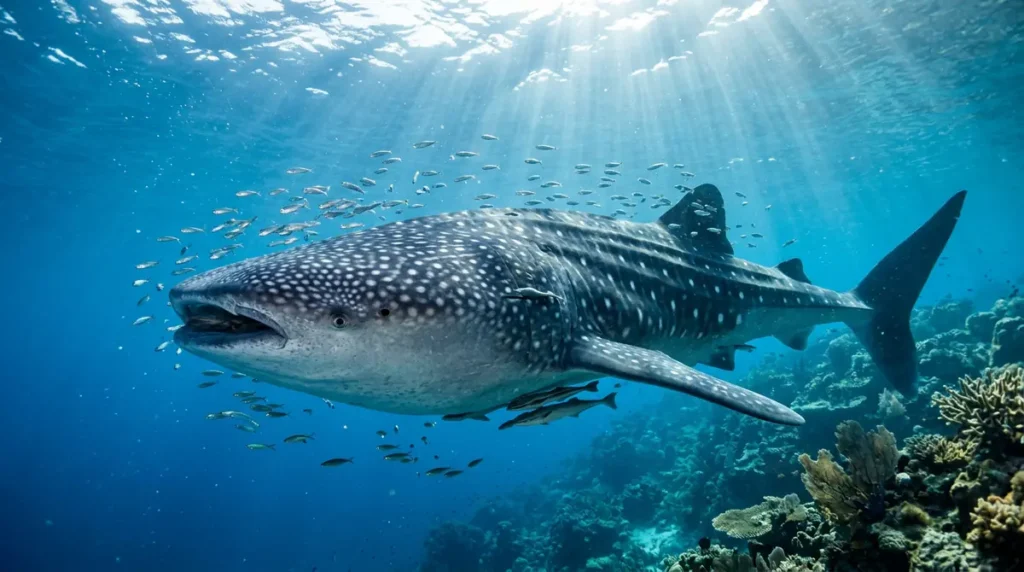
It is the largest living fish in the world and can reach approximately 13 metres in length, with some reports describing even larger individuals.
Its enormous body and beautiful spotted pattern make it one of the easiest large marine animals to recognize.
What Makes the Whale Shark So Unusual?
The Whale Shark has a wide, flattened head, a huge mouth, and a distinctive pattern of white spots and pale stripes across its dark body.
Unlike predatory sharks that hunt large prey, the Whale Shark is a filter feeder.
It swims through the water with its mouth open, collecting plankton, small fish, and other tiny marine organisms.
Another interesting feature is its gentle behavior. Despite its enormous size, it is generally not considered dangerous to humans when left undisturbed.
Whale Sharks also undertake long-distance movements across ocean regions in search of food.
Why Is the Whale Shark Endangered?
Whale Sharks face several threats, including accidental capture in fishing equipment, ship strikes, and illegal hunting.
Plastic pollution and changes in ocean conditions can also affect the marine environments where they feed.
Because Whale Sharks grow slowly and take many years to reach reproductive maturity, their populations can be difficult to recover after significant declines.
Marine conservation organizations are working to protect important feeding areas, reduce fishing-related deaths, and monitor their movements.
Interesting Fact: The Whale Shark is the largest living fish, but it survives mainly by filtering tiny food particles from the water.
Smalltooth Sawfish – The Rare Fish With a Tooth-Lined Snout
Scientific Name: Pristis pectinata
Native Location: Western Atlantic region, including parts of the Caribbean and the United States
Conservation Status: Critically Endangered
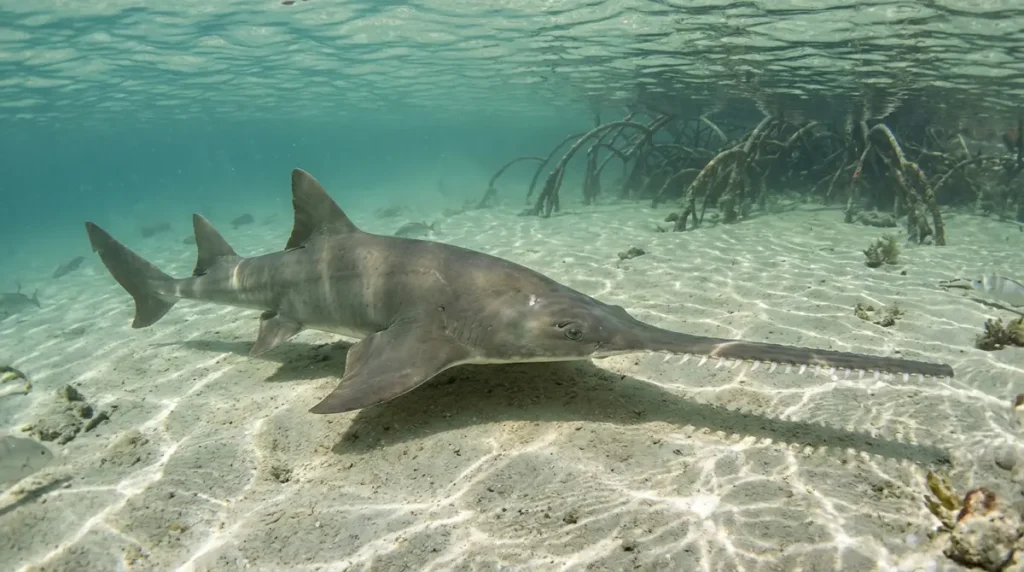
The Smalltooth Sawfish is another fascinating member of the sawfish family. At first glance, it looks like a combination of a shark and a mechanical saw.
Its long, flat snout is lined with small tooth-like structures, giving it an unusual appearance.
Although it belongs to the same group as rays, its body shape makes it resemble a shark.
What Makes the Smalltooth Sawfish So Unusual?
The most distinctive feature of the Smalltooth Sawfish is its long, toothed rostrum.
This special structure helps the fish detect and capture prey in shallow coastal waters.
It can move its snout from side to side to disturb small fish and other animals hiding nearby.
Its body is flattened underneath, with broad pectoral fins and a long tail.
Smalltooth Sawfish often use shallow coastal environments, estuaries, and mangrove areas during different stages of their lives.
Why Is the Smalltooth Sawfish Endangered?
Fishing nets are among the most serious threats to this species.
Its long snout can easily become tangled in fishing equipment, making accidental capture particularly dangerous.
Coastal habitat destruction also reduces important nursery areas where young sawfish grow.
Overfishing and the loss of mangrove environments have contributed to its disappearance from much of its historical range.
Conservation efforts now focus on protecting remaining populations, restoring coastal habitats, and reducing accidental fishing-related deaths.
Interesting Fact: Despite its shark-like appearance, the Smalltooth Sawfish is actually a type of ray.
Why Are Endangered Fish Important to Our Ecosystem?
Fish are not simply beautiful creatures living beneath the water. They play important roles in maintaining healthy aquatic ecosystems.
Different fish species help control populations of smaller organisms, recycle nutrients, maintain food chains, and support the balance of marine and freshwater environments.
When fish populations disappear, the effects can spread throughout the ecosystem.
Here are five major threats responsible for the decline of endangered fish.
1. Overfishing
Fishing faster than fish populations can reproduce reduces their numbers and makes recovery difficult.
Large and slow-growing fish are especially vulnerable.
2. Water Pollution
Industrial waste, agricultural chemicals, plastic, and untreated sewage can contaminate rivers, lakes, and oceans.
Polluted water can damage fish habitats, affect reproduction, and reduce food availability.
3. Habitat Destruction
Mangroves, coral reefs, seagrass beds, and freshwater spawning grounds provide essential shelter and breeding areas.
When these habitats disappear, many fish lose the environments they need to survive.
4. Dams and River Barriers
Dams can interrupt natural migration routes and prevent fish from reaching their breeding grounds.
Migratory species such as the European Eel and Chinese Sturgeon are particularly affected.
5. Climate Change
Rising water temperatures, changing ocean currents, and altered rainfall patterns can affect fish reproduction, food supplies, and habitat conditions.
How Can We Help Protect Endangered Fish?
Protecting fish populations requires cooperation between governments, conservation organizations, fishing communities, and individuals.
Here are some practical ways to support aquatic wildlife:
- Support organizations working to protect endangered marine and freshwater species.
- Avoid purchasing products made from illegally traded endangered fish.
- Reduce plastic waste and prevent rubbish from entering rivers and oceans.
- Support sustainable fishing practices.
- Protect wetlands, mangroves, coral reefs, and freshwater habitats.
- Spread awareness about endangered fish and their conservation needs.
- Support responsible tourism and avoid disturbing marine wildlife.
Even small changes in human behavior can help reduce pressure on vulnerable aquatic species.
Final Thoughts
The Red Handfish, Mekong Giant Catfish, European Eel, Green Sawfish, Chinese Sturgeon, Whale Shark, and Smalltooth Sawfish show how extraordinary the underwater world can be.
Some walk across the seabed using hand-like fins, others travel thousands of kilometres to reproduce, and some grow larger than small boats.
Unfortunately, these fascinating creatures face serious threats from human activities and environmental changes.
Protecting endangered fish means protecting the rivers, oceans, wetlands, and coastal habitats that support countless other living organisms.
By learning about these remarkable species and supporting conservation efforts, we can help ensure that the underwater world remains full of life for future generations.