Towering Heights: How 7 of the World’s Tallest Animals Adapted Their Necks
Imagine reaching the highest branches of a tree without climbing it, spotting a predator across an open grassland, or searching for food beneath the surface of a lake without struggling to bend your entire body. For some animals, these abilities are part of everyday life. Their necks are not simply anatomical features; they are highly specialized tools shaped by millions of years of evolution.
Across African savannas, Asian deserts, tropical wetlands, and northern forests, animals have developed remarkably different neck structures to solve the challenges of survival. Some have exceptionally long necks that help them reach food beyond the competition. Others rely on flexible neck bones for precise feeding movements, powerful muscles to support heavy heads, or specialized skin structures that assist with communication and temperature regulation.
But having a long neck also creates challenges. The head must remain stable during movement, blood must circulate efficiently, and muscles and ligaments must support the weight of the neck throughout the day. Each animal must balance these physical demands with the benefits its anatomy provides.
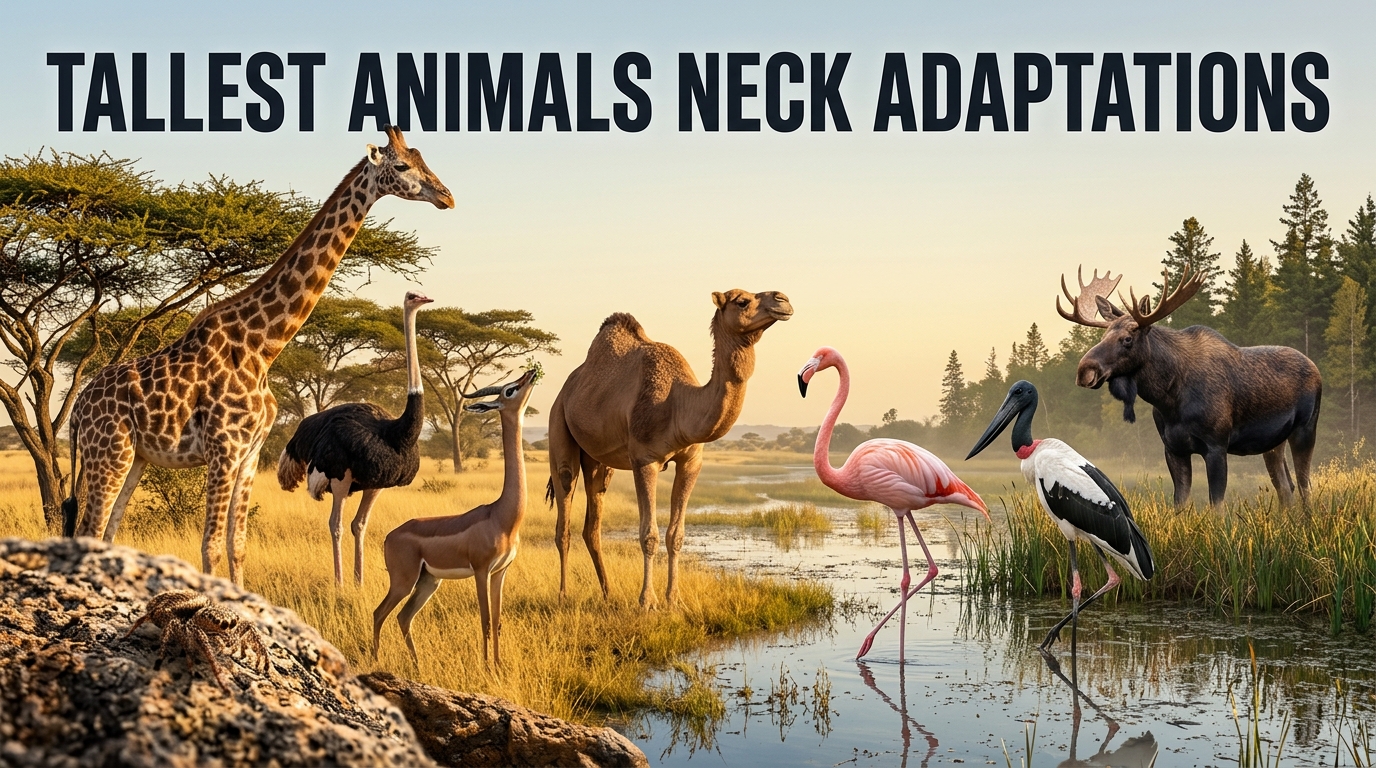
In this article, we explore seven remarkable animals and discover how their necks help them feed, move, detect danger, and survive in their natural habitats. From the towering giraffe to the powerful moose, their adaptations reveal how evolution can produce very different solutions to similar problems.
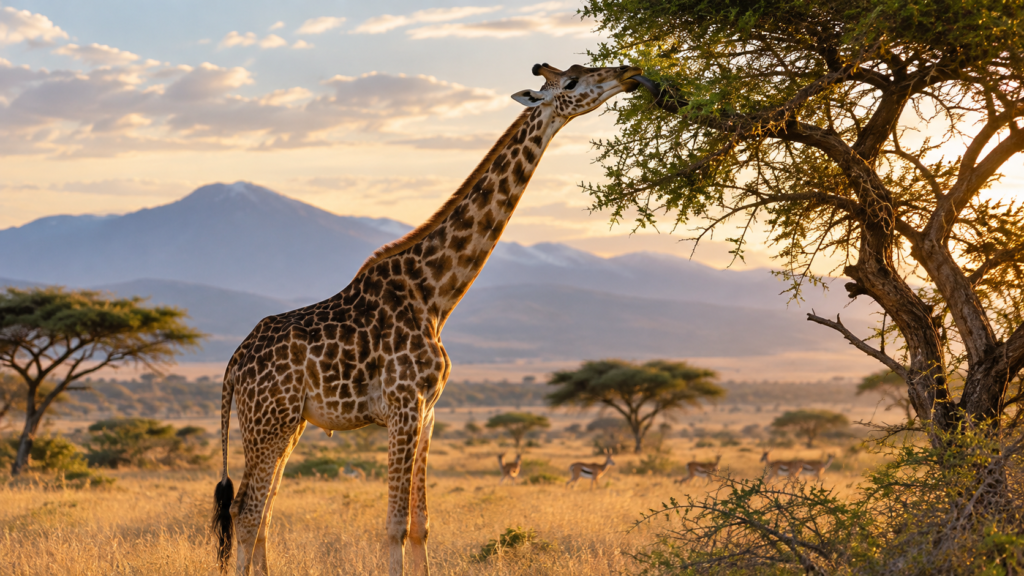
1. Giraffe (Giraffa camelopardalis): The Ultimate High-Canopy Browser
Total height: Approximately 14–19 feet (4.2–5.8 meters), depending on sex and individual
Neck length: Approximately 6 feet (1.8 meters), sometimes approaching 8 feet (2.4 meters)
The giraffe is the most recognizable example of an animal with an extraordinarily long neck. Standing above nearly every other land animal, it can reach foliage that many competing herbivores cannot access. Its towering appearance is impressive, but the real wonder lies in how its skeleton, muscles, ligaments, and circulatory system work together to support such an unusual body structure.
Seven vertebrae stretched to extraordinary lengths
Despite its enormous neck, the giraffe typically has just seven cervical vertebrae, the same number found in humans and most other mammals.
The difference is their size. Giraffe cervical vertebrae are greatly elongated, allowing the animal to develop a neck that can measure several feet in length without requiring dozens of additional bones.
These vertebrae support the neck’s weight while allowing enough movement for feeding, grooming, and looking around. Their joints, surrounding muscles, and connective tissues help maintain stability as the giraffe raises, lowers, or turns its head.
This is an important evolutionary lesson: a longer neck does not necessarily require more neck bones. In giraffes, modifying the length and structure of existing vertebrae produces the necessary reach.
A specialized system for controlling blood pressure
One of the giraffe’s greatest physiological challenges is supplying blood to its brain, which sits far above its heart. To overcome gravity, its cardiovascular system operates at unusually high blood pressures compared with those of most other mammals.
However, pumping blood upward is only half the problem. When the giraffe lowers its head to drink, the vertical distance between the heart and brain changes dramatically.
Specialized blood vessels, pressure-regulating mechanisms, and an interconnected network of small vessels help manage these changes. Elastic properties of the blood vessels and the effects of gravity also contribute to circulation. Together, these adaptations reduce the risk of dangerous pressure fluctuations when the animal moves its head between high and low positions.
Rather than relying on a single anatomical feature, the giraffe uses a coordinated cardiovascular system to cope with its unusual body proportions.
The nuchal ligament: A natural support system
Holding a heavy neck upright would require enormous muscular effort if the giraffe relied on its muscles alone.
Fortunately, it has a strong elastic structure called the nuchal ligament, which extends from the upper neck toward the back and supports the head and neck. This ligament helps carry much of their weight, reducing the continuous muscular effort required to maintain an upright posture.
The neck’s muscles remain essential for movement, feeding, and stabilization, but the ligament makes prolonged support more energy-efficient.
Why does the giraffe need such a long neck?
The most obvious advantage is access to high foliage, particularly leaves from acacia trees and other woody plants. This allows giraffes to exploit feeding opportunities that many shorter herbivores cannot reach.
Neck length may also help males compete during fights known as necking. They swing their heads and necks against opponents, using the weight and momentum of their bodies to establish dominance.
Survival advantage: The giraffe combines extraordinary feeding height with a specialized circulatory system and supportive connective tissues, allowing it to use its long neck without sacrificing essential bodily functions.
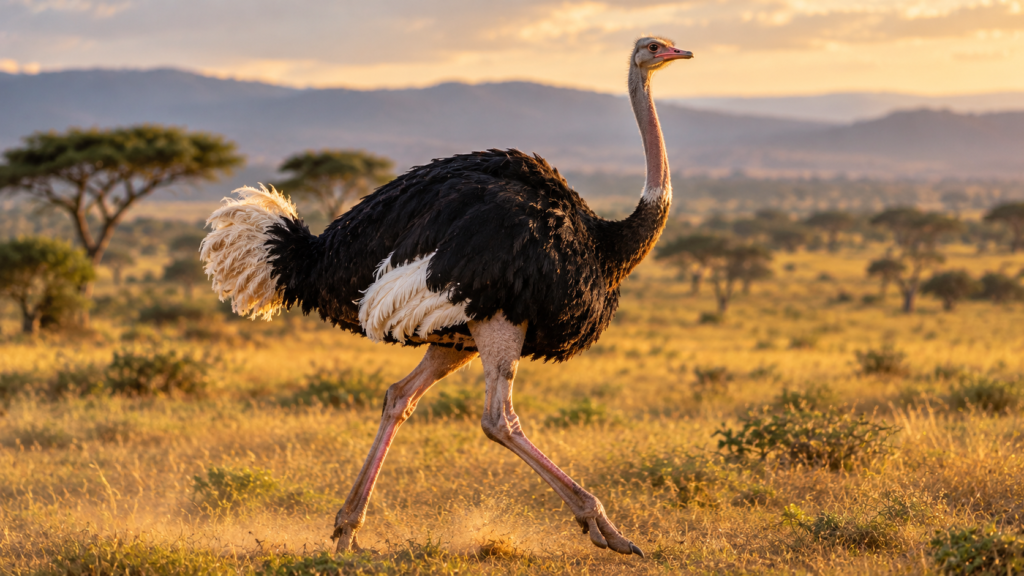
2. Common Ostrich (Struthio camelus): A Tall Lookout Across the Grasslands
Total height: Approximately 7–9 feet (2.1–2.7 meters), with some individuals approaching 9.5 feet
Neck length: Roughly 3 feet (0.9 meters), varying among individuals
The ostrich is the world’s largest living bird, and its long, largely featherless neck gives it an excellent view across the open African landscapes where it lives.
Unlike a giraffe, which uses its neck primarily to reach high vegetation, the ostrich benefits from a combination of visibility, mobility, and precise head positioning. Its neck is an important part of a body built for life on the ground.
More neck vertebrae mean greater flexibility
Mammals generally have seven cervical vertebrae, but birds can have different numbers depending on the species.
Ostriches possess numerous elongated cervical vertebrae, commonly described as around 17, although counts can vary with anatomical definitions and individual references. These bones allow the neck to bend and extend in ways that would be difficult with a rigid structure.
The flexibility helps an ostrich inspect its surroundings, reach food on the ground, and reposition its head rapidly when responding to movement.
Its long neck also allows it to move its head independently of its powerful body, helping it gather visual information while walking or running.
An elevated view of approaching danger
Ostriches inhabit open habitats where predators can sometimes be detected at a distance. Their elevated heads and large eyes help them monitor their surroundings, although vegetation, terrain, lighting, and the position of a predator all affect how far they can see.
Early detection matters because ostriches depend heavily on running to escape danger. Their long legs, powerful muscles, and efficient stride allow them to reach speeds of around 40–45 miles per hour (64–72 kilometers per hour) under suitable conditions.
The neck contributes to this mobile system by allowing the head to change position as the body accelerates and moves across uneven ground. However, it is more accurate to view the neck as part of the ostrich’s overall balance and movement system than as a single, proven counterweight responsible for its running speed.
How the ostrich uses its neck to find food
Ostriches are omnivorous. They consume a variety of plant material, seeds, and other foods, including insects and small animals when available.
Their long necks let them lower their heads toward the ground without requiring the entire body to crouch. They can inspect and pick up food while standing or walking, making feeding convenient across wide areas.
Survival advantage: The ostrich’s flexible neck provides mobility, helps position its large eyes for environmental awareness, and makes ground-level feeding easier for a tall, fast-running bird.
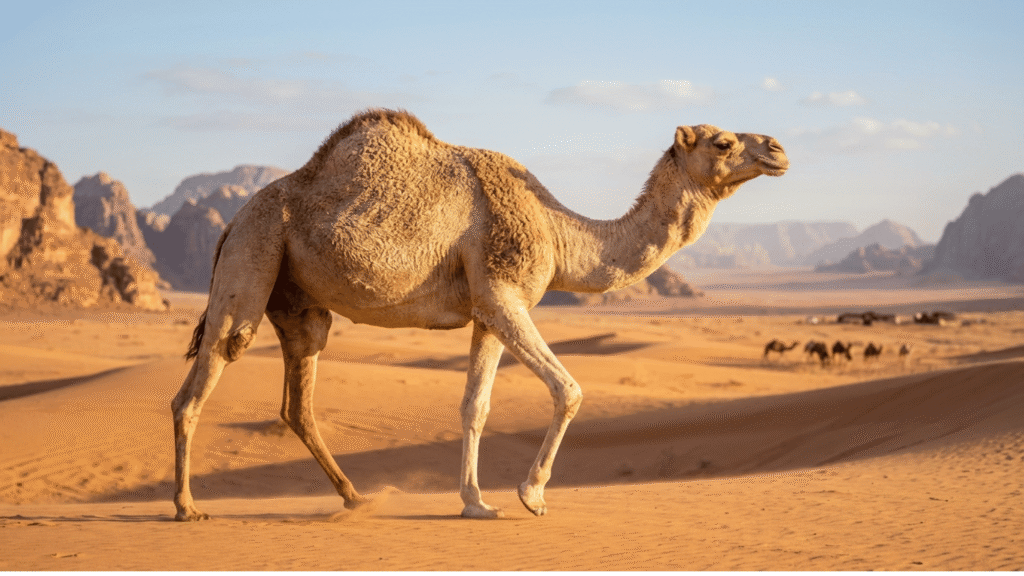
3. Dromedary Camel (Camelus dromedarius): A Long Neck Built for Desert Foraging
Total height: Approximately 6.5–7.5 feet (2–2.3 meters) at the shoulder in many adults, with the head and neck raising the overall height further
Neck length: Commonly around 3–4 feet (0.9–1.2 meters), with variation among individuals
The dromedary camel is famous for its single hump, but its long neck is another important part of its adaptation to arid environments. In deserts and dry regions, food can be scattered, thorny, or difficult to reach. A camel’s neck allows it to explore different feeding heights while keeping its large body relatively stable.
A curved neck for reaching different feeding levels
The camel’s neck has a curved profile that allows the head to move between higher branches and lower vegetation. Its elongated cervical vertebrae and strong muscles provide the reach and control needed for browsing.
This flexibility is useful when feeding on shrubs, thorny plants, and trees that grow in dry landscapes. Camels can extend their heads toward foliage and adjust their neck position to select edible leaves and shoots.
Their tough mouths and lips also help them handle some coarse and thorny vegetation that many other herbivores find difficult to eat.
Feeding without repeatedly repositioning the whole body
Camels have long legs that elevate their bodies above the ground. Although this gives them a useful view and helps them travel through their environment, it also creates a challenge when they need to feed on low plants.
Their long necks help bridge the distance between the elevated body and vegetation at different heights. Instead of moving their entire bodies for every mouthful, they can lower or extend their heads as they browse.
They can also bend their necks to reach food close to the ground. Kneeling is not required for ordinary grazing, although camels commonly kneel when resting or being loaded.
Is the long neck an adaptation for desert survival?
The neck itself does not store water or prevent dehydration. Instead, it supports a flexible feeding strategy in environments where food availability can change with rainfall and season.
By reaching different types of vegetation, camels can make use of available plant resources across a varied landscape. Their broader desert survival depends on many additional adaptations, including efficient water conservation, tolerance of heat, and the ability to consume relatively poor-quality forage.
Survival advantage: The camel’s long, mobile neck expands its feeding range, helping it reach shrubs and trees while also allowing it to feed on lower vegetation.
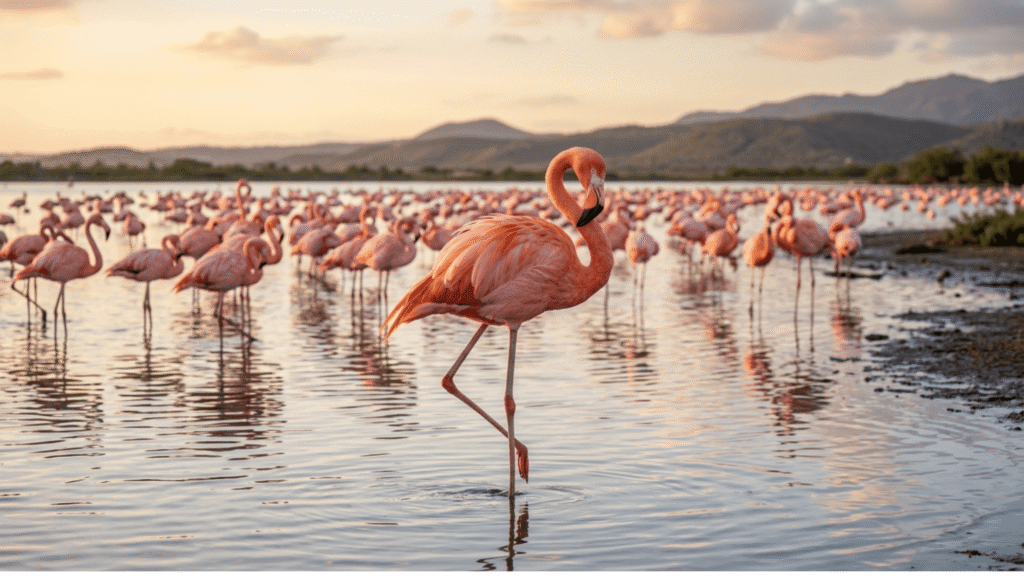
4. Greater Flamingo (Phoenicopterus roseus): A Flexible Neck for Filter Feeding
Total height: Approximately 3.9–4.7 feet (1.2–1.4 meters)
Neck length: Often around 2.5–3 feet (0.75–0.9 meters), depending on the individual
The greater flamingo’s pink plumage attracts attention, but its long neck is central to the way it feeds in shallow wetlands, lagoons, and saline lakes.
Unlike the giraffe’s neck, which raises the mouth toward high foliage, the flamingo’s neck allows its bill to reach down into water and mud. Its flexibility also helps position the bill for a feeding technique that is unusual among birds.
A long neck with numerous vertebrae
Flamingos have many more cervical vertebrae than mammals such as giraffes. The greater flamingo is commonly described as having around 19 cervical vertebrae, giving its neck considerable flexibility.
The vertebrae and surrounding soft tissues allow the neck to curve into an S-shape and move through a wide range of positions.
This flexibility is particularly useful because the bird often feeds with its head lowered and its bill inverted. The neck helps bring the bill into the right position without forcing the entire body into an awkward posture.
Why does a flamingo feed upside down?
Flamingos use specialized bills to filter small food particles from water and sediment. Depending on the location and availability of food, their diet can include algae, tiny aquatic organisms, crustaceans, and other small food items.
While feeding, a flamingo lowers its head into shallow water and turns its bill upside down. Specialized structures inside the bill help separate edible particles from water and mud.
Its neck allows it to sweep the bill through the feeding area, repeatedly adjusting the angle and depth as it searches for food.
The bird does not need to submerge its entire head deeply. Instead, it positions the bill in the water while maintaining a posture suited to its feeding method.
Feeding in a challenging environment
Flamingos frequently inhabit shallow lakes and wetlands where water conditions can vary substantially. Some species, including greater flamingos, can use saline or alkaline habitats that many other birds cannot exploit as readily.
Their specialized bills, filtering mechanisms, and flexible necks work together to make these feeding areas useful sources of food.
Survival advantage: The flamingo’s long, flexible neck allows it to position its inverted bill precisely, making filter feeding in shallow water more efficient.
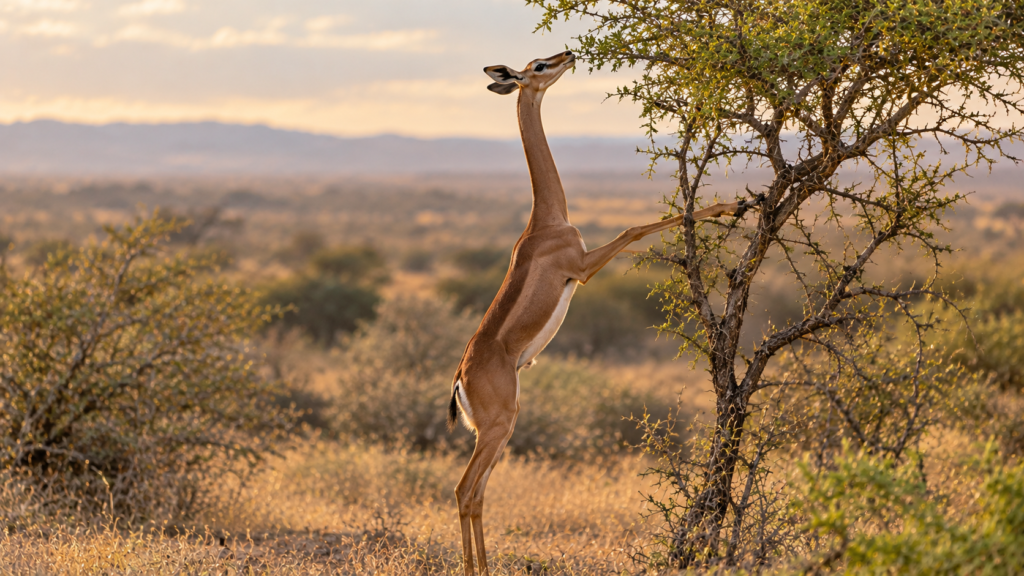
5. Gerenuk (Litocranius walleri): The Antelope That Reaches Like a Giraffe
Standing height: Approximately 3–3.5 feet (0.9–1.1 meters) at the shoulder
Neck: Elongated relative to its body, helping it reach elevated foliage
The gerenuk is a slender African antelope found in dry scrublands and bushland in parts of East Africa. Its name comes from a Somali word meaning “giraffe-necked,” a reference to its long, narrow neck and distinctive feeding posture.
Although it is much smaller than a giraffe, the gerenuk has developed a different way to exploit vegetation above the reach of many other antelopes.
An elongated neck for browsing shrubs
Gerenuks feed mainly on leaves, shoots, flowers, and other parts of woody plants. Their long necks allow them to extend their heads into shrubs and branches, while their relatively small heads and narrow muzzles help them select particular plant parts.
This feeding strategy is especially valuable in dry environments, where lush grass may be scarce and shrubs provide an important source of food.
Unlike grazing antelopes that depend heavily on grass, gerenuks can take advantage of vegetation growing above ground level.
Standing on two legs to reach even higher
One of the gerenuk’s most remarkable behaviors is its ability to stand upright on its hind legs while browsing.
It raises the front part of its body and may brace itself with its hind legs and tail as it reaches toward higher branches. Its long neck then extends the feeding range even further.
The posture depends on the coordination of the animal’s limbs, body muscles, and balance. It is not simply a matter of having a long neck; the gerenuk’s slender body and long legs make this feeding behavior possible.
Some individuals can reach foliage several feet above the ground, including leaves that other browsing animals may not easily access.
How this reduces competition for food
When multiple herbivore species share the same habitat, they may compete for the same plants. By feeding at different heights and selecting particular leaves and shoots, gerenuks can reduce overlap with animals that mainly graze on grass or browse closer to the ground.
This does not eliminate competition, but it allows them to exploit a more specialized feeding niche.
Survival advantage: The gerenuk combines an elongated neck with an upright browsing posture, allowing it to reach elevated foliage in dry habitats where food can be limited.
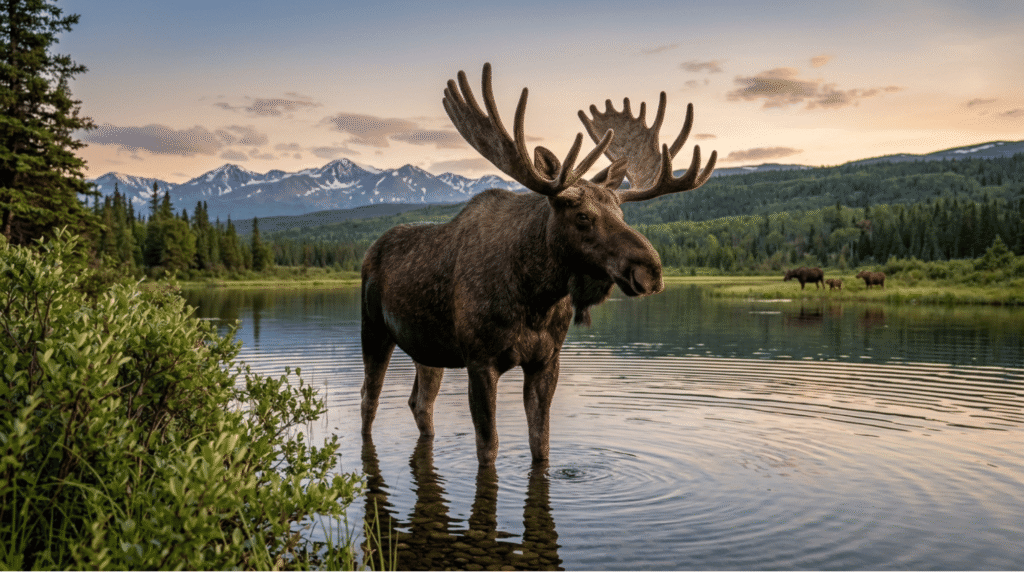
6. Alaskan Moose (Alces alces gigas): A Powerful Neck for a Massive Body
Shoulder height: Commonly around 5.5–7 feet (1.7–2.1 meters) in large adults, with variation by sex and individual
Neck structure: Relatively short and robust compared with the necks of giraffes and other long-necked animals
Not every evolutionary success story involves an exceptionally long neck. The Alaskan moose, a large subspecies of moose found in Alaska and neighboring regions, demonstrates a different approach: a powerful body, strong neck muscles, and a head adapted to support substantial antlers in males.
Its neck may appear modest beside that of a giraffe, but its structure suits the demands of a large animal living in forests, wetlands, and cold northern environments.
A strong neck for a heavy head
Adult male moose develop enormous palmate antlers, which can span several feet and weigh many pounds. The exact weight varies considerably with the animal’s age, condition, and antler size.
Supporting and moving a large head with such antlers requires substantial muscles and strong connections between the neck, skull, and upper body.
The moose’s robust neck helps stabilize its head while feeding, moving through vegetation, and engaging in physical displays or contests with other males.
However, antler support is only part of the story. Moose anatomy must also accommodate the animal’s overall size and its characteristic feeding behaviors.
Reaching food in forests and wetlands
Moose feed on a variety of plants, including leaves, twigs, buds, and aquatic vegetation. Their long legs raise their bodies above the ground, while their necks help them reach vegetation at different heights.
They often browse willow, birch, and other shrubs, especially when young shoots and leaves are available. They also feed on aquatic plants in lakes and ponds during warmer months.
When feeding underwater, a moose can lower its head and muzzle beneath the surface to reach submerged vegetation. This behavior takes advantage of its large body, long legs, and feeding anatomy rather than relying on neck length alone.
Why a shorter, stronger neck can be advantageous
A long, slender neck is useful when the primary task is reaching high foliage. A powerful neck, on the other hand, is suited to supporting a heavy head and controlling its movement.
The moose’s body illustrates that natural selection does not always favor maximum length. Instead, anatomy evolves in relation to the demands an animal repeatedly faces.
Survival advantage: The moose’s muscular neck supports its large head and antlers while providing the strength and mobility needed for browsing and feeding in forest and wetland habitats.
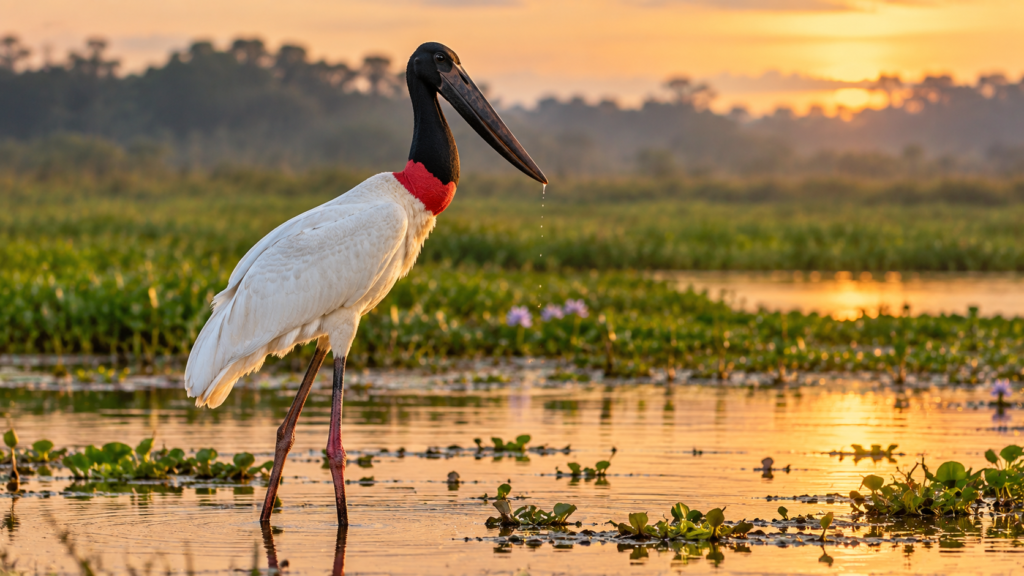
7. Jabiru Stork (Jabiru mycteria): A Long Neck for Wetland Hunting
Total height: Approximately 4–5 feet (1.2–1.5 meters)
Neck length: Roughly 2 feet (0.6 meters), varying with body size
The jabiru is a large stork native to parts of Central and South America. It lives in wetlands, marshes, floodplains, and other habitats where fish and aquatic animals can provide abundant food.
Its long legs, long bill, and mobile neck help it hunt in shallow water. It also has a distinctive appearance, with a largely white body, a dark head and upper neck, and a conspicuous red area near the base of the neck.
A flexible neck for catching prey
The jabiru often hunts by wading through shallow water and watching for suitable prey. Its diet includes fish, amphibians, crustaceans, and other small aquatic animals.
When prey comes within reach, the stork can rapidly extend its head and bill to seize it. A flexible neck allows it to adjust the angle and position of the bill without having to move its entire body toward every target.
This is particularly useful in wetlands, where a sudden movement may disturb prey or make hunting more difficult.
The neck also helps the jabiru inspect different parts of the water and reposition its head as it searches for food.
What is the red area on its neck?
One of the jabiru’s most recognizable features is the red patch of bare skin near the base of its dark neck. The area can become more intensely colored, particularly during courtship and display.
It is important, however, not to confuse this feature with a large inflatable throat pouch. The jabiru’s red skin region is a distinctive patch rather than the prominent, expandable pouch found in certain other bird species.
Its bright coloration is associated with visual signaling, while the neck itself provides the reach and mobility needed for hunting.
How does the jabiru cope with tropical heat?
Birds use several methods to regulate their body temperatures, including adjustments to blood flow in exposed body surfaces and behavioral changes such as seeking shade.
Bare skin can play a role in heat exchange because it is not covered by insulating feathers. However, the red patch alone should not be treated as a specialized cooling organ without stronger evidence.
The jabiru’s overall temperature regulation depends on its physiology and behavior, just as its hunting success depends on the combined function of its neck, bill, legs, and eyesight.
Survival advantage: The jabiru’s mobile neck allows it to strike accurately at aquatic prey, while its distinctive bare skin provides a visible feature used in social displays.
What Makes These Seven Neck Adaptations Different?
At first glance, these animals seem to share one defining feature: unusual neck anatomy. Yet the underlying purposes differ substantially.
The giraffe and camel use their necks to access vegetation at different heights. The gerenuk combines neck length with an unusual standing posture to reach leaves in dry scrublands. The ostrich benefits from flexible head positioning and an elevated view across open terrain, while the flamingo uses its neck to place its specialized bill in shallow water.
The moose demonstrates that a relatively short, powerful neck can be better suited to supporting a heavy head and antlers. The jabiru, meanwhile, uses a flexible neck to catch prey in wetlands.
These differences show why neck length alone is not a reliable measure of an animal’s adaptability. The number and shape of vertebrae, the strength of connective tissues, the muscles surrounding the neck, and the animal’s feeding behavior all matter.
Comparison Table: Seven Animals and Their Neck Adaptations
| Animal | Main neck-related advantage | Important structural or behavioral feature |
|---|---|---|
| Giraffe | Reaching high tree foliage and competing with other males | Seven greatly elongated cervical vertebrae, strong nuchal ligament, specialized blood-pressure regulation |
| Common ostrich | Positioning the head for feeding and environmental awareness | Numerous flexible cervical vertebrae and an elevated head |
| Dromedary camel | Browsing shrubs and trees at different heights | Long, curved neck with strong supporting muscles |
| Greater flamingo | Reaching food during upside-down filter feeding | Numerous flexible vertebrae and specialized bill mechanics |
| Gerenuk | Reaching elevated leaves in dry scrublands | Elongated neck combined with upright, hind-leg browsing |
| Alaskan moose | Supporting a heavy head and antlers while feeding | Robust neck muscles and strong skeletal support |
| Jabiru stork | Reaching and capturing prey in wetlands | Mobile neck, long bill, and rapid head extension |
Why Did Animals Evolve Such Different Necks?
The differences among these seven animals highlight a fundamental principle of evolution: body structures are shaped by the demands of survival and reproduction in particular environments.
1. Food availability shapes neck structure
Animals that feed on vegetation often benefit from reaching food that other species cannot easily access. Giraffes browse high tree canopies, camels exploit shrubs in dry landscapes, and gerenuks reach leaves above the level of many competing herbivores.
Flamingos and jabirus show a different relationship between neck structure and food. Their necks help them position their bills for feeding in shallow water rather than reach elevated vegetation.
2. Vertebrae balance flexibility and stability
A neck must be flexible enough to perform useful movements but stable enough to support the head.
Elongated vertebrae increase reach, while joints, muscles, ligaments, and connective tissues control movement. Birds such as ostriches and flamingos generally have more cervical vertebrae than mammals, giving them different anatomical possibilities.
However, vertebral number alone does not determine flexibility. The shapes of the bones, their joints, and the surrounding tissues are also important.
3. Large bodies create different mechanical demands
A tall animal needs to control the movement of its head while standing, feeding, or traveling. A very long neck can increase the leverage and muscular effort required to support the head.
The giraffe relies partly on a strong nuchal ligament to support its neck. The moose uses a more robust muscular structure suited to its large head and antlers.
These are different solutions to the same broad challenge: maintaining control over the head without wasting unnecessary energy.
4. Feeding behavior matters as much as neck length
The gerenuk’s upright browsing, the flamingo’s inverted filter feeding, and the jabiru’s rapid prey capture all depend on coordinated movements of the neck and other body parts.
A neck is therefore not an isolated adaptation. It functions as part of a larger system involving the skeleton, muscles, sensory organs, limbs, and feeding structures.
5. Evolution involves trade-offs
Longer necks can increase feeding reach, but they can also increase the weight and leverage that muscles and supporting tissues must manage. Specialized feeding postures may provide access to otherwise unavailable food, but they require coordination and suitable body proportions.
Evolution does not produce a universally perfect neck. It produces structures that work well enough within the environmental and biological conditions faced by a species over many generations.
Frequently Asked Questions
Which animal has the longest neck in the world?
The giraffe has the longest neck among living animals. Its neck can measure around 6 feet (1.8 meters), with some estimates approaching 8 feet (2.4 meters), depending on the individual and how the measurement is taken.
How many neck bones does a giraffe have?
A giraffe normally has seven cervical vertebrae, the same number found in humans. Its neck is so long because these vertebrae are greatly elongated.
Do all tall animals have long necks?
No. Some tall animals have relatively short or robust necks. The moose, for example, has a strong neck suited to supporting its head and, in males, heavy antlers. Height, neck length, and neck strength are different anatomical characteristics.
Why does a flamingo bend its neck while feeding?
A flamingo uses its flexible neck to position its bill upside down in shallow water or sediment. Its specialized bill then filters small food particles from the surrounding material.
Why does the gerenuk stand on its hind legs?
Standing upright allows the gerenuk to reach leaves and shoots growing higher on shrubs and small trees. Its elongated neck extends its reach, helping it exploit feeding opportunities that may be less accessible to other antelopes.
Does a giraffe’s long neck help it survive without water?
Not directly. The neck helps the giraffe reach food, while its ability to cope with periods of limited water depends on other physiological and behavioral adaptations. Neck length should not be confused with water storage or dehydration resistance.
Is a long neck always better for survival?
No. The value of a particular neck structure depends on the animal’s lifestyle and environment. A long neck may improve access to food, while a shorter, muscular neck may provide better support for a heavy head. The most useful structure is the one that suits the animal’s ecological needs.
Conclusion: Seven Necks, Seven Different Survival Strategies
The giraffe, ostrich, camel, flamingo, gerenuk, moose, and jabiru demonstrate that neck anatomy is about much more than height.
For the giraffe, an extraordinary neck opens access to high tree canopies and requires specialized support and circulation. The ostrich uses its mobile neck as part of a body designed for ground feeding and rapid escape. The camel reaches vegetation across dry landscapes, while the flamingo positions its bill for specialized filter feeding. The gerenuk combines an elongated neck with an upright stance, the moose relies on muscular strength to support a powerful head, and the jabiru uses neck mobility to capture prey in wetlands.
Each example reveals the close relationship between anatomy, behavior, and environment. Long necks, flexible necks, and muscular necks are not competing designs in a universal contest. They are different evolutionary solutions to different challenges.
The next time you see a giraffe reaching into a treetop or a flamingo feeding in shallow water, remember that the shape of its neck reflects a much larger story: how living creatures gradually develop the structures and behaviors that help them find food, navigate their surroundings, and pass their genes to future generations.