7 Hilarious Reasons Dogs Get the Zoomies (And What It Means)
Every dog parent knows the moment: one second your pup is resting peacefully, and the next, they have tucked their tail, flattened their ears, and are sprinting full-speed around the living room like a manic whirlwind. Known scientifically as Frenetic Random Activity Periods (FRAPs), “zoomies” are one of the most widespread and entertaining dog behaviors. While they look completely wild and bizarre, they actually serve a fascinating purpose in canine psychology.
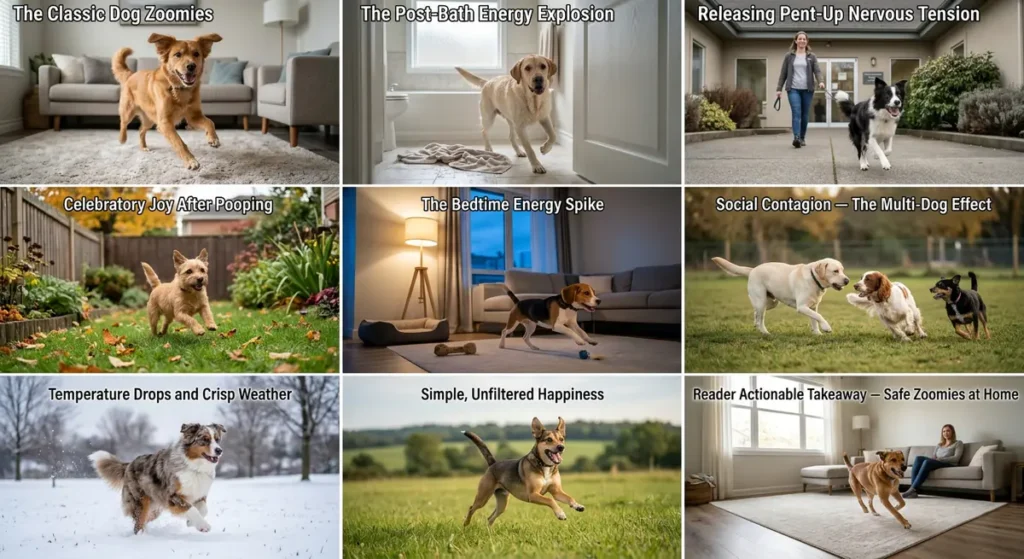
1. The Post-Bath Energy Explosion
Why do dogs instantly lose their mind after a bath? Washing away their natural scent triggers an intense instinctual drive to rub off the wet feeling and reclaim their familiar odor. Running at top speed helps evaporate moisture from their coat while burning off the stress of being restrained in water.
2. Releasing Pent-Up Nervous Tension
Zoomies often occur immediately following a tense or high-focus event, such as a vet checkup, a training session, or being crated while you were at work. The sudden burst of running acts as an emotional release valve, allowing their nervous system to reset to a calm state.
3. Celebratory Joy After Pooping
Many owners notice their dogs sprinting away from the yard directly after taking a bowel movement. This phenomenon is caused by a physiological drop in abdominal pressure combined with pure relief, triggering a happy surge of natural endorphins.
4. The Bedtime Energy Spike
Puppies and young adult dogs frequently experience a bout of late-evening zoomies right before falling asleep. Just like tired toddlers, overtired dogs experience a brief hormonal spike of cortisol and adrenaline before their body finally surrenders to rest.
5. Social Contagion (The Multi-Dog Effect)
Zoomies are highly contagious. When one dog begins sprinting and bowing, neighboring dogs interpret the posture as a universal play invitation. The collective energy amplifies, resulting in synchronized, hilarious yard laps.
6. Temperature Drops and Crisp Weather
Dogs regulate their body temperature far better in cool weather than in heat. The sudden arrival of autumn air or cold winter snow invigorates their respiratory system, prompting spontaneous bursts of play to warm up their muscles.
7. Simple, Unfiltered Happiness
Sometimes, zoomies require no complex psychological explanation. A dog sprinting across a open grassy field or across a soft carpet is simply demonstrating pure, unadulterated joy and celebrating being alive.
Reader Actionable Takeaway
Zoomies are entirely normal and healthy! To keep your dog safe during a zoomie episode, ensure they are on non-slip rugs or grass, clear away sharp coffee table corners, and never attempt to chase them—instead, let them burn off the energy naturally.
Why Dogs Sleep in Bizarre Positions (And What They Mean)
If you’ve ever found your dog sleeping completely upside down with all four paws sticking straight into the air, or wedged sideways into an impossibly tight crevice, you aren’t alone. Dogs are notorious for adopting sleeping poses that look wildly uncomfortable to humans. However, a dog’s sleeping posture provides deep insights into their comfort level, body temperature, and emotional state.
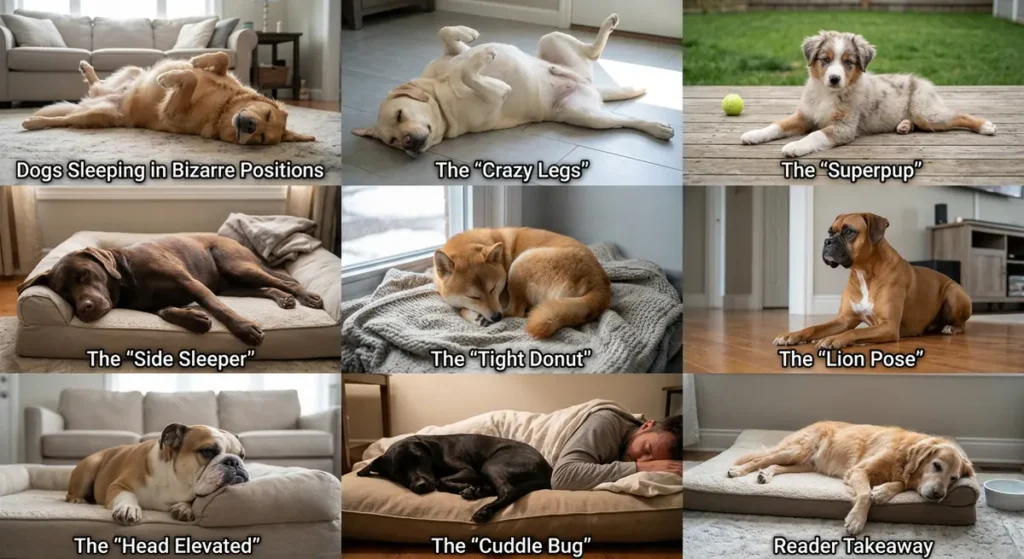
1. The “Crazy Legs” (On Their Back with Paws Up)
This is the ultimate sign of a relaxed and trusting dog. Exposing their belly and vulnerable organs indicates complete security in their environment. Additionally, because dogs sweat only through their paw pads and have thinner fur on their bellies, this posture allows maximum heat dissipation during warmer months.
2. The “Superpup” (Splayed Out flat on the Belly)
Popular among puppies and high-energy breeds, the Superpup position involves lying flat on the stomach with front legs stretched forward and back legs stretched behind. This pose indicates that while the dog is resting, they are ready to leap into action and play at a second’s notice.
3. The “Side Sleeper”
Dogs lying on their side with legs extended are experiencing deep, restorative sleep (REM sleep). This position signifies high comfort with their family and surroundings, as it leaves their vital organs exposed and requires enough physical safety to completely relax their muscles.
4. The “Tight Donut” (Tucked into a Ball)
When a dog curls up with their nose tucked under their tail, they are preserving body heat and protecting their internal organs. While common in cold weather, it is also a protective instinct inherited from wild ancestors who slept in exposed dens.
5. The “Lion Pose” (Sphinx Resting)
In this position, the dog rests with their head on top of their front paws. Rather than deep sleep, this pose indicates light resting. The dog’s muscles remain engaged so they can react immediately if they hear a noise or see their owner move.
6. The “Head Elevated” Perch
Dogs that consistently prefer sleeping with their head elevated on a pillow, couch armrest, or dog bed bolster may simply enjoy the comfort—or it could indicate they find it easier to breathe in that alignment, which is common in brachycephalic (flat-faced) breeds like Bulldogs and Pugs.
7. The “Cuddle Bug” (Back-to-Back)
If your dog insists on sleeping pressed directly against your back or against another pet, they are exhibiting pack-bonding behavior. In the wild, sleeping in a tight pile provided warmth and mutual protection from predators.
Reader Actionable Takeaway
Pay attention to how your dog adjusts their sleeping position relative to the room temperature and their daily activity levels. Providing a supportive orthopedic bed helps them stretch out safely without putting undue stress on their joints.
Unlocking the Mystery of the Dog “Derp” Face
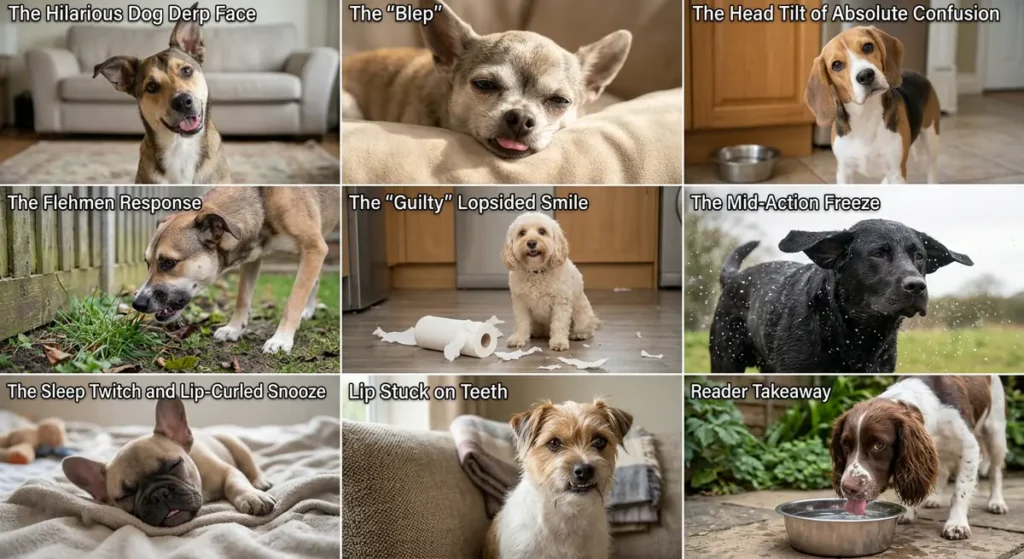
Few things on the internet bring as much instant joy as a photo of a dog caught making an utterly clueless or “derpy” expression. Whether it’s a tiny sliver of tongue sticking out (a “blep”), cross-eyed confusion over a flying frisbee, or a lopsided smile while getting chin scratches, these comical moments make up a huge part of canine charm. But what causes these silly faces?
1. The “Blep” (Forgotten Tongue Syndrome)
A “blep” or “derp tongue” happens when a dog lets the tip of their tongue hang out of their mouth. This frequently occurs after a long yawn, during deep relaxation, or when a dog is missing front teeth (incisors), which normally act as a natural barrier holding the tongue inside.
2. The Head Tilt of Absolute Confusion
When you speak in a high-pitched voice or say key words like “walk” or “treat,” your dog may tilt their head drastically to one side. This goofy movement adjusts their outer ears to better pinpoint the location and tone of the sound, while moving their snout out of their line of sight so they can read your facial expressions better.
3. The Flehmen Response (Smelling with an Open Mouth)
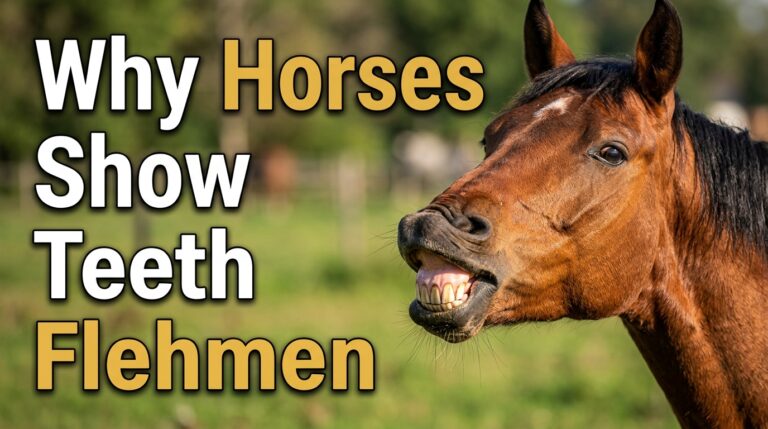
Have you ever seen your dog curl their top lip back and curl their tongue after sniffing a lamp post or grass patch? This funny, grimacing expression is called the Flehmen response. It transfers scent molecules to the vomeronasal organ (Jacobson’s organ) located in the roof of their mouth for deeper chemical analysis.
4. The “Guilty” Lopsided Smile
When caught doing something naughty, dogs often squint their eyes, flatten their ears, and display a lopsided, submissive grin. While humans interpret this as guilt, behavioral science shows it is actually a appeasement gesture intended to defuse tension and signal submission.
5. The Mid-Action Freeze (Mid-Catch or Mid-Shake)
Action cameras catching dogs in high-speed moments expose incredible expressions—such as jowls flying wild during a water shake or eyes wide with shock as a tennis ball bounces off their nose. These goofy faces show the physical forces at play during high-speed canine movement.
6. The Sleep Twitch and Lip Curled Snooze
During REM sleep, dogs process memories and dream about chasing squirrels or fetching balls. This results in hilarious face twitches, muffled barks, rapidly moving eyelids, and lip curls while completely unconscious.
7. Lip Stuck on Teeth (The “Teefies”)
Sometimes a dog’s upper lip gets caught on their canine teeth due to dry gums, creating a lopsided, snaggle-toothed expression. It is completely harmless and usually happens right after waking up or after a long panting session.
Reader Actionable Takeaway
While derpy expressions are usually harmless and adorable, a suddenly hanging tongue accompanied by drooling or lethargy can indicate dental issues or heat fatigue. Always ensure your silly pup stays hydrated!
7 Absurd Things Dogs Do When They Think You Aren’t Looking
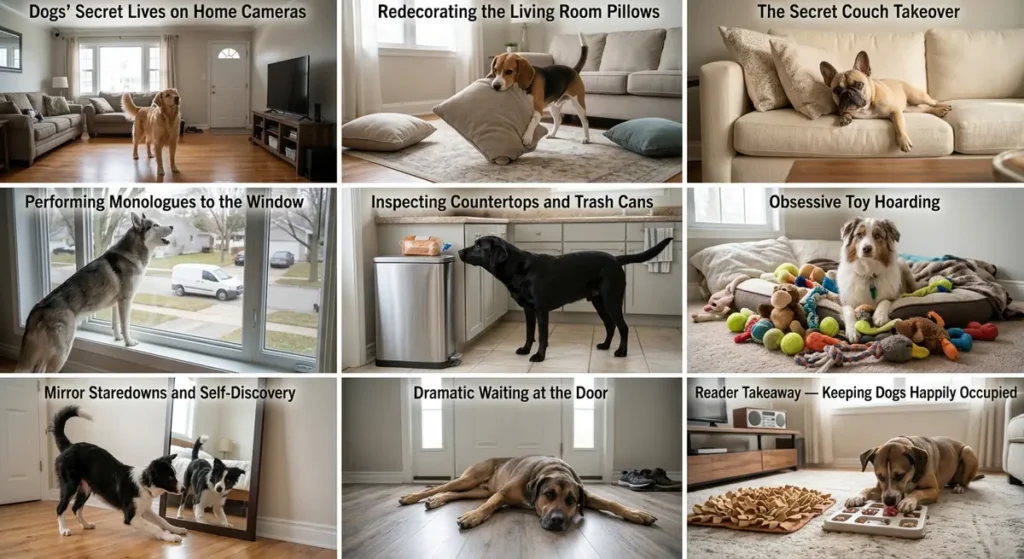
Thanks to the rise of pet cameras and smart home security systems, dog owners have gained an unprecedented look into the secret lives of their pets. When dogs think their human audience has left the building, their behavior shifts from polite companion to hilarious free-agent. Here are seven of the most bizarre and funny behaviors dogs engage in when they think nobody is watching.
1. Redecorating the Living Room Pillows
The moment the front door closes, many dogs embark on home renovation projects. This includes systematically pulling couch cushions onto the floor to build a custom nesting site, or rearranging floor mats to create a softer lounge area.
2. The Secret Couch (or Bed) Takeover
Even dogs strictly trained to stay off the furniture often break the rules the second they hear the car drive away. Pet cameras frequently capture dogs cautiously approaching the couch, sniffing for human presence, and then leaping onto forbidden cushions with sheer delight.
3. Performing Monologues to the Window
When left alone, dogs often adopt a “neighborhood watch” persona. They may spend hours standing on couch backs, emitting tiny, low-frequency huffs, grumbles, or full-blown opera howls at passing delivery trucks, leaves, or distant squirrels.
4. Inspecting Countertops and Trash Cans
Curiosity takes over when supervision disappears. Dogs will execute carefully planned reconnaissance missions, stretching their necks to smell every inch of the kitchen counter or gently nudging trash cans to test the stability of the lid.
5. Obsessive Toy Hoarding
Rather than playing with one toy, some dogs will walk around the house, collect every single toy from their basket, and deposit them into a central pile on their bed. Creating a “toy hoard” provides them with a comforting sense of resource security while their humans are away.
6. Mirror Staredowns and Self-Discovery
Young dogs and curious breeds sometimes catch their own reflection in a low mirror or glass door while home alone. This often results in a funny standoff featuring play bows, low growls, and sideways head tilts at the “other dog” in the room.
7. Dramatic Waiting at the Door
Nothing compares to the dramatic flair of a waiting dog. Hours before you return, your pup might lie down in an exaggerated, sprawling pose directly in front of the entryway, letting out long, theatrical sighs every few minutes until they hear your keys.
Reader Actionable Takeaway
Interactive puzzle toys, snuffle mats, and leaving a radio on low can keep your dog entertained and mentally stimulated during hours when they might otherwise get up to goofy mischief.
The Science Behind Why Dogs Steal Your Socks
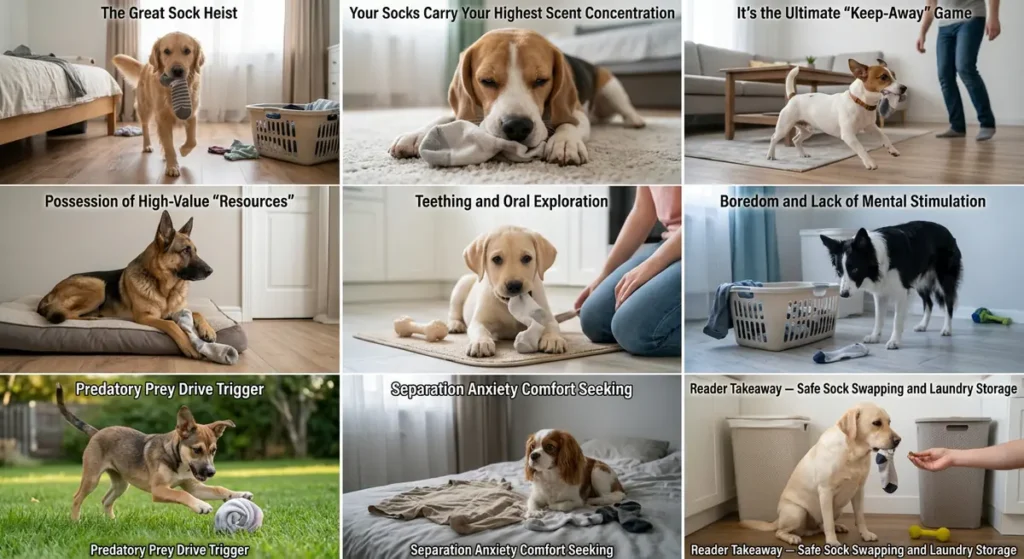
You put down a clean pair of socks, turn around for two seconds, and glance back to find your dog trotting away proudly with a sock hanging out of their mouth. Sock stealing is one of the most common, quirky, and frustratingly goofy habits exhibited by dogs across all breeds. But why do our canine companions have such a deep obsession with our footwear and laundry?
1. Your Socks Carry Your Highest Scent Concentration
A dog’s sense of smell is roughly 10,000 to 100,000 times more acute than a human’s. Human feet contain thousands of sweat glands, making socks the most concentrated source of your personal scent in the entire house. Holding your sock provides your dog with a comforting sense of closeness to you.
2. It’s the Ultimate “Keep-Away” Game
Dogs quickly learn cause and effect. If they pick up a rubber toy, you might ignore them. But the second they pick up a dirty sock, you jump up, shout their name, and chase them around the coffee table. To a dog, this reaction is the best game of tag ever invented.
3. Possession of High-Value “Resources”
To a dog, items that belong to the “pack leader” hold high value. Carrying a sock around the house acts as a status symbol or a comfort item, similar to a security blanket for a human child.
4. Teething and Oral Exploration
Puppies explore the physical world through their mouth. The texture of soft cotton, wool, or athletic socks offers a satisfying mouthfeel, especially for young dogs going through the uncomfortable teething phase between 4 and 8 months old.
5. Boredom and Lack of Mental Stimulation
If a dog isn’t receiving enough daily physical exercise or mental enrichment, they will invent their own jobs. Hunting down loose socks around the house gives them a clear task and fires up their instinctual foraging drive.
6. Predatory Prey Drive Trigger
Rolling up a pair of socks into a ball creates an object that closely resembles a small prey animal in size and weight. Catching, tossing, and pouncing on a soft sock ball activates a dog’s natural predatory sequence in a harmless way.
7. Separation Anxiety Comfort Seeking
Dogs experiencing mild separation anxiety often head straight for the laundry basket when their owners leave. Surroundings filled with heavily scented items like socks and worn t-shirts help soothe their nervous system during lonely hours.
Reader Actionable Takeaway
Never swallow warning: Ingesting socks can cause dangerous intestinal blockages! Trade your sock for a high-value treat or toy rather than chasing your dog, and keep laundry baskets elevated off the floor.
7 Hilarious Communication Signals Dogs Use to Control Humans
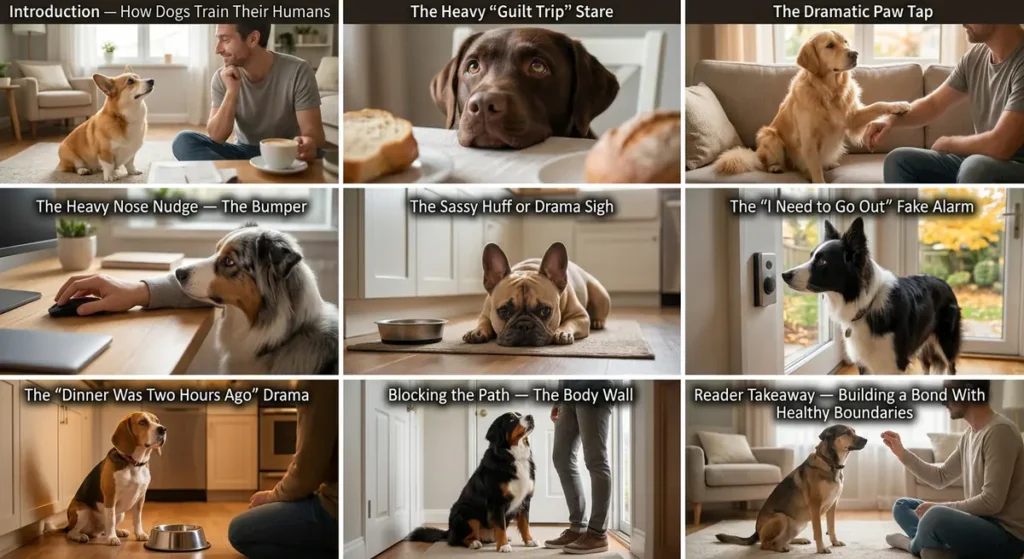
We like to think we are the ones training our dogs, but the reality is often the exact opposite. Over thousands of years of domestication, dogs have mastered the art of human communication. They have developed a series of subtle, hilarious, and undeniably effective behaviors designed to get exactly what they want—whether it’s an extra treat, an earlier dinner, or a spot on the bed.
1. The Heavy “Guilt Trip” Stare
Dogs have perfected the unblinking, soulful gaze. By raising their inner eyebrows (an evolutionary trait developed specifically to interact with humans), they create large “puppy dog eyes” that trigger a surge of oxytocin in human brains, making it nearly impossible to refuse them a piece of crust from your sandwich.
2. The Dramatic Paw Tap
When you stop petting your dog, do they immediately reach out a single paw and slap it onto your leg or arm? Known as “pawing,” this goofy behavior is a direct demand for continued affection. If it works once, the dog registers it as an effective command.
3. The Heavy Nose Nudge (The Bumper)
If you are typing at your desk or scrolling on your phone, your dog might slide their snout directly under your elbow or hand, flipping your arm upward. This pushy yet sweet gesture forces your hand right onto their head for immediate scratches.
4. The Sassy ” Huff” or Drama Sigh
When a dog is told “no” or forced to wait for dinner, they often drop their head onto their paws and let out a loud, theatrical sigh through their nose. This “huff” is a funny expression of mild frustration and dramatic disappointment.
5. The “I Need to Go Out” Fake Alarm
Smart dogs quickly figure out that ringing a door chime or whining at the back door gets immediate action from their owners. Once they master this trick, many dogs start ringing the bell not because they need a bathroom break, but because they want to go chase a leaf or lie in the sun.
6. The “Dinner Was Two Hours Ago” Drama
Dogs have a remarkably accurate internal biological clock. If dinner is normally served at 5:00 PM, your dog may begin hovering nearby at 4:30 PM, engaging in lopsided walks, floor licking, and intense staring to convince you that they are on the brink of starvation.
7. Blocking the Path (The Body Wall)
When you grab your shoes or coat, your dog might walk directly in front of you and sit down on your feet. By physically blocking your path, they use goofy passive resistance to prevent you from leaving or to remind you to grab their leash first.
Reader Actionable Takeaway
Recognizing these funny signals helps build a deeper bond with your dog! However, ensure you set healthy boundaries so their cute manipulation tactics don’t turn into demanding behavior.
The “Sploot” Phenomena: Why Dogs Stretch Like Frogs
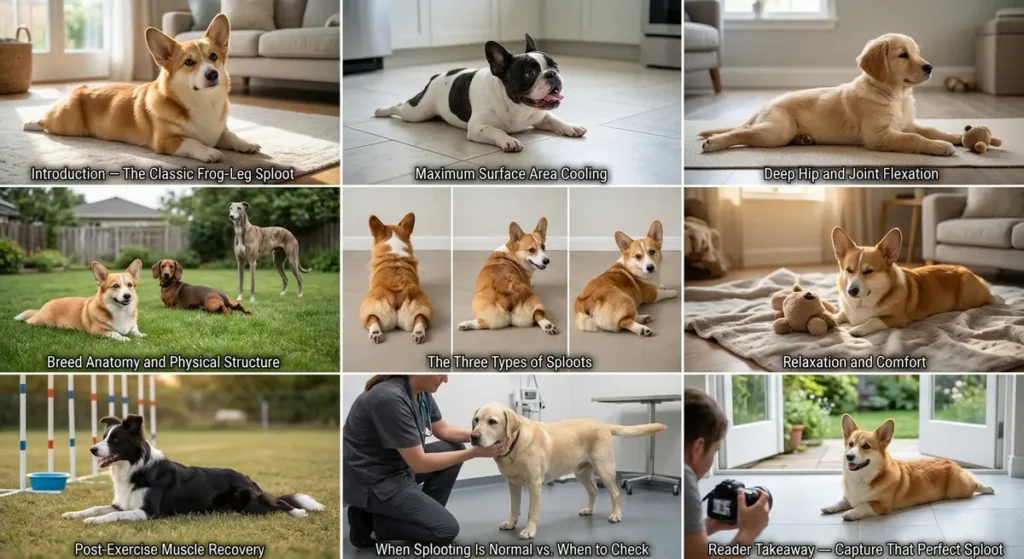
If you’ve ever seen a dog lie flat on their belly with both back legs kicked straight out behind them like a frog, you’ve witnessed the glorious posture known across the internet as a “sploot.” Popularized by breeds like Corgis and French Bulldogs, splooting looks incredibly silly, but it is actually a natural and functional physical posture. Here is everything you need to know about why dogs sploot.
1. Maximum Surface Area Cooling
The primary physical reason dogs sploot on hardwood, tile, or stone floors is temperature regulation. A dog’s belly has significantly less fur than their back. By spreading their body as flat as possible against a cold floor, they maximize heat transfer and cool down rapidly after exercise.
2. Deep Hip and Joint Flexation
Splooting provides a deep, comfortable stretch for a dog’s hips, thighs, and lower back muscles. Younger dogs and puppies with flexible joints often sploot effortlessly because their hip sockets are pliable and relaxed.
3. Breed Anatomy and Physical Structure
Certain dog breeds are structurally predisposed to splooting. Breeds with shorter legs and long torsos (like Corgis, Dachshunds, and Basset Hounds) or heavy-set muscular frames (like Bulldogs and Pugs) sploot far more frequently than tall, long-legged breeds like Greyhounds.
4. The Anatomy of the 3 Types of Sploots
Dog enthusiasts classify splooting into three distinct styles:
- The Full Sploot: Both back legs are kicked straight out behind the body simultaneously (the classic “frog dog”).
- The Half Sploot: One back leg is kicked straight out while the other remains tucked neatly under the belly.
- The Side Sploot: One hip is leaned to the side while both legs stick out at a lopsided angle.
5. Relaxation and Comfort
When a dog is completely comfortable in their home environment, splooting allows them to relax every major muscle group at once. Because it takes a second to scramble up from a full sploot, dogs only adopt this pose when they feel totally safe.
6. Post-Exercise Muscle Recovery
After a long walk, run, or agility session, splooting helps relieve tension in the rear leg flexors and pelvic region, serving as the canine equivalent of a post-workout cool-down stretch.
7. When Splooting Is Normal vs. When to Check
For most dogs—especially puppies and flexible breeds—splooting is a totally healthy, harmless habit. However, if an older dog who has never splooted suddenly starts doing so, or if splooting is accompanied by stiffness, difficulty standing, or limping, it is worth asking your vet to check their hips and joints.
Quick Tip
Capture those sploots on camera! It’s a wonderful indicator that your pup feels secure, cool, and relaxed in your home.