
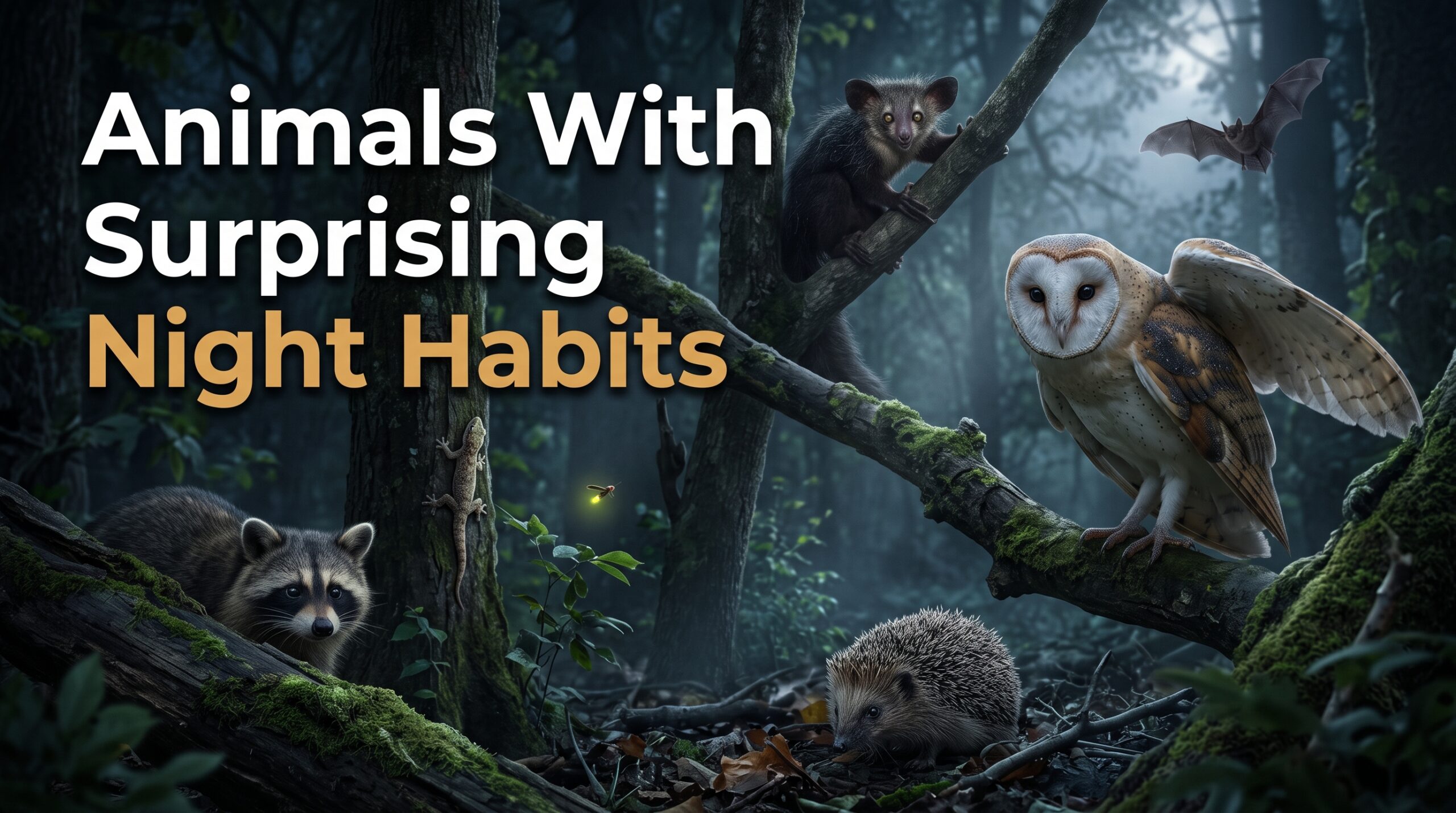
Animals With Surprising Night Habits: 7 Fascinating Creatures That Come Alive After Dark
When the sun disappears below the horizon and most people settle down for the night, an entirely different world begins to awaken. Across forests, grasslands, deserts, and even busy cities, animals emerge from their hiding places to hunt, search for food, communicate, and explore their surroundings. Some navigate through complete darkness using sound, while others silently approach their prey or use the cooler nighttime hours to escape the heat.
But the most fascinating part of animal behavior is that the night is not simply a time for sleeping — for many creatures, it is when their most extraordinary abilities come into action.
Have you ever wondered how a bat catches a tiny insect without seeing it clearly? Why can an owl fly almost silently toward its prey? Or how can a small hedgehog travel through the darkness searching for food while avoiding danger?
These behaviors are not random. They are adaptations that help animals survive in environments where light is limited, predators are active, and food may be difficult to find. Nocturnal animals often rely on highly developed senses, unusual hunting strategies, and carefully timed routines to make the most of the night.
In this article, we will explore seven animals with surprising night habits, discovering what they do after dark, how their unusual behaviors work, and why these nighttime activities are essential to their survival.
7 Animals With Surprising Night Habits
Here is a quick look at the seven fascinating animals featured in this article.
- Barn Owl
Surprising habit: Nearly silent flight
Its specialized feathers help reduce the sound of flight, allowing it to approach prey with remarkable stealth.
- Bat
Surprising habit: Hunting with sound
Many bats use echolocation to detect insects and avoid obstacles in darkness.
- Raccoon
Surprising habit: Exploring food with sensitive paws
Its front paws help it investigate objects, handle food, and search for meals in the dark.
- Hedgehog
Surprising habit: Long nighttime food searches
This small mammal travels around after dark, using its nose and hearing to locate food.
- Gecko
Surprising habit: Hunting insects in dim light
Many geckos forage at night and have eyes adapted to low-light conditions.
- Firefly
Surprising habit: Producing light to communicate
Many fireflies use glowing signals to attract mates, turning the darkness into a natural signaling system.
- Aye-aye
Surprising habit: Tapping trees to find hidden food
This unusual nocturnal lemur taps branches and uses its specialized middle finger to extract insect larvae from wood.
These animals demonstrate seven very different ways of living after dark. Let’s explore each one in detail.
-
Barn Owl: The Bird That Hunts Almost Silently
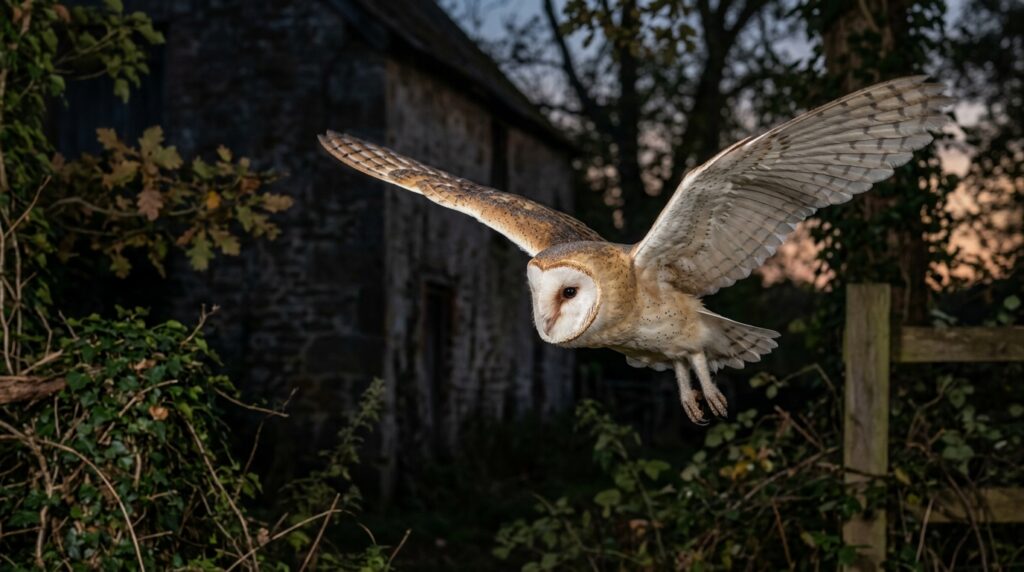
The barn owl is one of the most impressive nighttime hunters in the animal kingdom. With its heart-shaped face, pale feathers, and extraordinary hearing, this bird can locate small animals in darkness with remarkable accuracy. But its most surprising nighttime habit is the almost silent way it flies toward its prey.
Unlike many birds whose wings create noticeable flapping sounds, barn owls have specialized feathers that help reduce aerodynamic noise. Their wing feathers have soft surfaces and finely structured edges that help control the sound produced as air passes over the wings. This gives the owl an important advantage when hunting animals that might otherwise hear an approaching predator.
How does a barn owl hunt in the dark?
A barn owl does not depend on eyesight alone. Its hearing is highly specialized for detecting the faint sounds made by small animals moving through grass, leaves, or other ground cover.
Its facial feathers form a sound-collecting structure that directs noises toward its ears. When a mouse rustles through vegetation, the owl can use these sounds to estimate where the animal is hiding. The bird may then adjust its head position, swoop downward, and seize its prey with its powerful feet and sharp talons.
This hunting technique is particularly useful on moonless nights, when visibility is poor. Although owls have excellent low-light vision, their hearing allows them to hunt effectively even when their prey is difficult to see.
Why is silent flight so important?
Imagine a mouse searching for seeds beneath a layer of dry leaves. A noisy predator could alert the mouse before getting close enough to catch it. By reducing the sound of its approach, the barn owl has a better chance of surprising its prey.
Silent flight also illustrates how several adaptations can work together. The owl’s feathers reduce noise, its ears detect subtle sounds, and its feet are designed to capture prey. These features make it an efficient nighttime hunter.
Surprising fact: The barn owl’s heart-shaped facial disc is not merely a distinctive feature. It helps collect and direct sound toward its ears, improving its ability to locate prey.
-
Bat: The Mammal That Uses Sound Instead of Sight
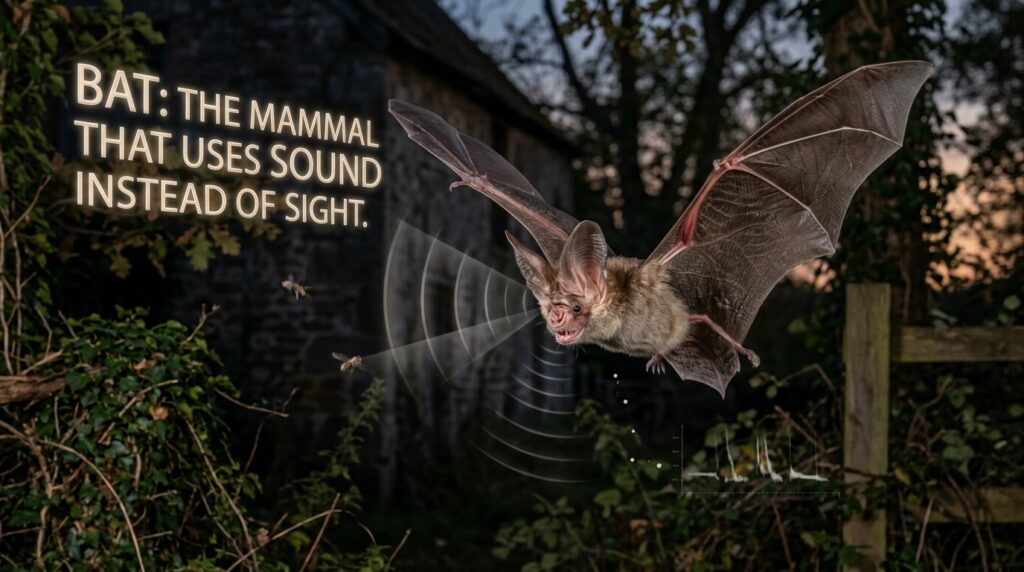
Bats are among the most fascinating nocturnal animals because many of them can navigate and hunt in darkness using a biological system that resembles sonar. Instead of relying entirely on their eyes, these bats produce high-frequency sounds and listen for the echoes that return from nearby objects.
This ability is called echolocation. It allows many bat species to locate flying insects, avoid obstacles, and navigate through complicated environments after sunset.
How does echolocation work?
The process begins when a bat produces a series of short, high-frequency calls. These sound waves travel through the air until they strike an object, such as a branch, wall, or flying insect.
Some of the sound reflects toward the bat. By analyzing the returning echoes, the bat can estimate the object’s distance, direction, and certain physical characteristics.
As a bat approaches an insect, its calls may become much more frequent. This rapid sequence helps it track the insect’s movement and adjust its flight path at the last moment.
Humans generally cannot hear many of these calls because they occur at frequencies above the normal range of human hearing. Specialized recording equipment can detect the sounds and convert them into signals that researchers can analyze.
What happens when a bat catches an insect?
A bat’s nighttime hunt is a fast sequence of detection, tracking, and capture.
First, the bat searches an area where insects are likely to be present, such as above a pond, beside trees, or near a forest clearing. Once it detects a suitable target, it changes its flight direction and increases the frequency of its echolocation calls.
The bat then makes a rapid turn or swoop to capture the insect with its mouth or, in some species, its wing or tail membrane. The entire process may happen so quickly that a human observer sees only a brief change in flight direction.
Not every bat hunts in exactly the same way. Some species depend heavily on echolocation, while others also use vision, smell, or the sounds made by their prey.
Why are bats important at night?
Insect-eating bats help control populations of many nighttime insects. Their feeding activity makes them important members of ecosystems, including agricultural landscapes and forests.
Their ability to hunt after dark also allows them to exploit food sources that may be less accessible to daytime predators.
Surprising fact: Some bats can change the pattern of their calls depending on whether they are searching for food, approaching prey, or communicating with other bats. Their nighttime sound system is much more sophisticated than simply making a repeated squeak.
-
Raccoon: The Nighttime Explorer With Sensitive Paws
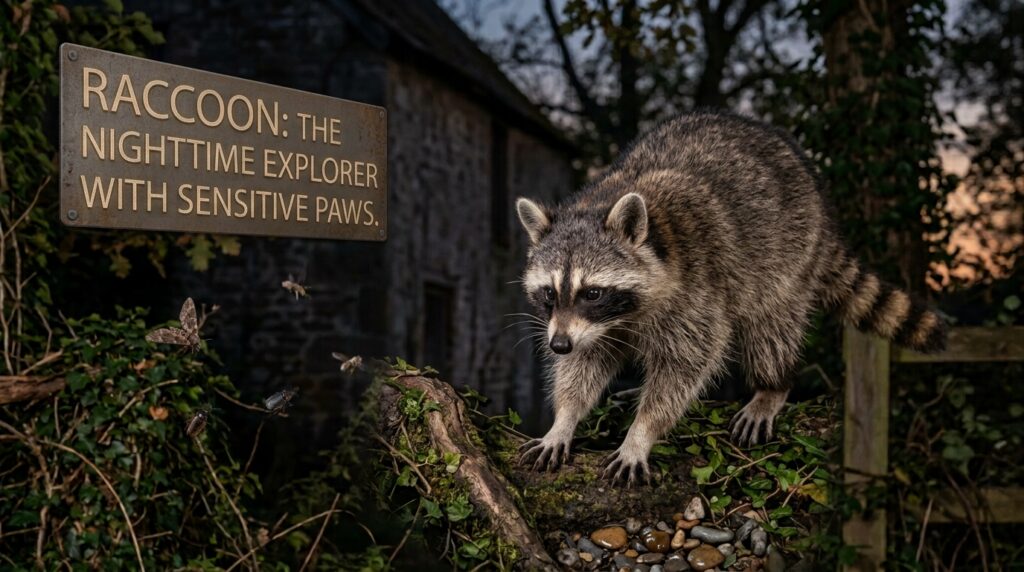
Raccoons are well known for their masked faces, clever behavior, and ability to investigate almost anything they encounter. Many raccoons are most active at night, when they search for food in forests, wetlands, suburban neighborhoods, and urban areas.
Their most interesting nighttime habit is the way they use their front paws to explore objects and handle food. Raccoons have highly sensitive forepaws that help them gather information about the things they touch.
How do raccoons find food after dark?
Raccoons are opportunistic omnivores, meaning they eat a wide variety of foods depending on what is available. Their diet can include insects, fruits, nuts, eggs, small animals, and aquatic prey.
After sunset, a raccoon may move along a stream, investigate fallen logs, search beneath leaves, or explore a garden. Rather than relying exclusively on eyesight, it can use its paws to feel around crevices and investigate objects that might contain food.
Its sensitive forepaws are particularly useful in situations where visibility is limited. Touch provides additional information about the texture, shape, and movement of objects.
Raccoons also have a strong sense of smell, which helps them identify possible food sources. Their combination of touch, smell, hearing, and vision makes them versatile nighttime foragers.
Why do raccoons appear to wash their food?
One behavior that frequently surprises people is the raccoon’s habit of rubbing or manipulating food in water. This has earned raccoons a reputation for washing their meals before eating.
However, the behavior is not necessarily equivalent to human washing. Raccoons often explore and handle objects with their paws, and wetting their paws can increase the sensitivity of their tactile exploration. The behavior may occur even when there is no obvious need to clean the food.
Scientists cannot assume that every raccoon performs this action for exactly the same reason. What looks like washing may involve a combination of food handling, exploration, and species-typical behavior.
How do raccoons survive around humans?
Raccoons are highly adaptable animals. In some places, they learn to search for food in garbage bins, gardens, and other human-modified environments.
Their nighttime activity can help them avoid some human disturbance, although raccoons do not always avoid people and may be active during daylight as well.
Their intelligence and curiosity can be useful, but these traits also bring risks. Traffic, unsecured rubbish, and contact with domestic animals can threaten raccoons living near people.
Surprising fact: A raccoon’s paws are more than tools for grabbing objects. They are important sensory organs that help the animal investigate its surroundings while searching for food.
-
Hedgehog: The Small Mammal That Travels After Dark
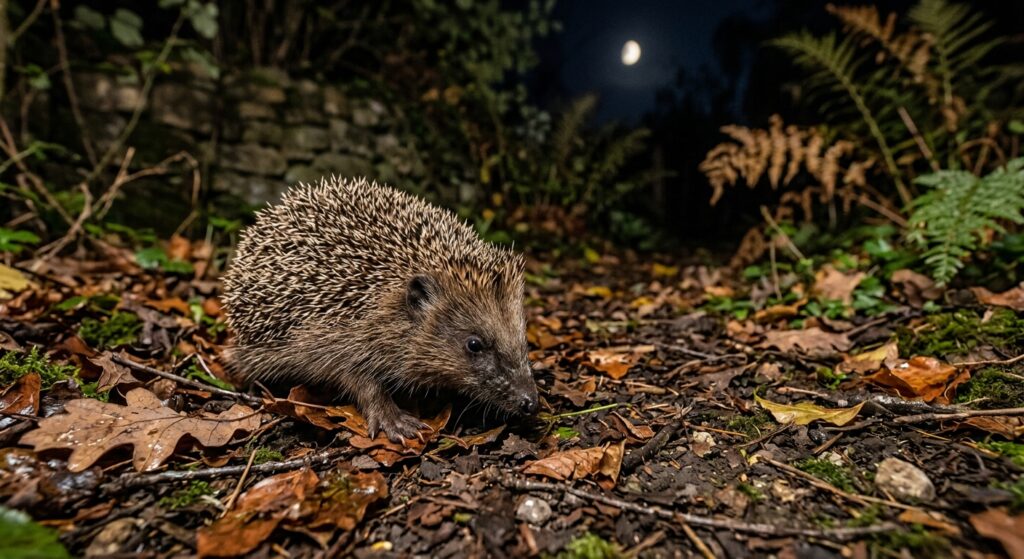
Hedgehogs may look slow and vulnerable, but their nighttime routines reveal a surprisingly active side. These small mammals often spend daylight hours resting in sheltered places and emerge after sunset to search for food.
Their nightly journeys can take them through gardens, grasslands, woodland edges, and other habitats where insects and other small food sources are available.
The surprising part is that a hedgehog may travel a considerable distance in one night despite its small body and short legs. The distance varies with habitat, season, food availability, and the individual animal. The Natural History Museum notes that hedgehogs can travel up to around 1.5 kilometres during an evening’s foraging.
What does a hedgehog do during the night?
A hedgehog’s nighttime routine is largely centered on finding food. Depending on the species and its environment, its diet may include beetles, caterpillars, earthworms, and other small invertebrates.
As it moves through vegetation, the hedgehog frequently pauses to sniff the ground and investigate places where prey may be hiding. It may search beneath fallen leaves, around the base of plants, or through patches of damp soil.
Its sense of smell is particularly important for locating food. Hearing also helps it notice sounds in its surroundings, while its eyesight plays a role in general navigation.
The animal does not simply walk in a straight line throughout the night. Instead, its route can involve repeated searches of promising areas, changes in direction, and movement between sheltered locations.
Why do hedgehogs prefer the darkness?
Nighttime activity offers several advantages. Temperatures are often cooler, and some of the small animals hedgehogs eat are more accessible during damp or dark conditions.
Staying sheltered during the day may also reduce exposure to certain predators and disturbances. However, these advantages vary by habitat, and hedgehogs can still face threats from predators, vehicles, and human activities.
Their spines provide a defensive adaptation. When threatened, a hedgehog can curl into a tight ball, exposing its spines and protecting its more vulnerable body parts. This is a defensive response rather than a hunting technique.
What happens when morning arrives?
As daylight approaches, a hedgehog typically searches for a safe resting place. Depending on the season, it may shelter in dense vegetation, beneath a structure, or inside a nest made from leaves and other natural materials.
Its daytime rest helps it maintain a pattern of activity suited to its environment. In colder regions, some hedgehog species also undergo hibernation or prolonged seasonal inactivity.
Surprising fact: A small hedgehog can cover a large area relative to its body size while searching for food. Its nighttime life involves much more movement and exploration than its quiet daytime appearance suggests.
-
Gecko: The Reptile That Hunts Insects in Dim Light
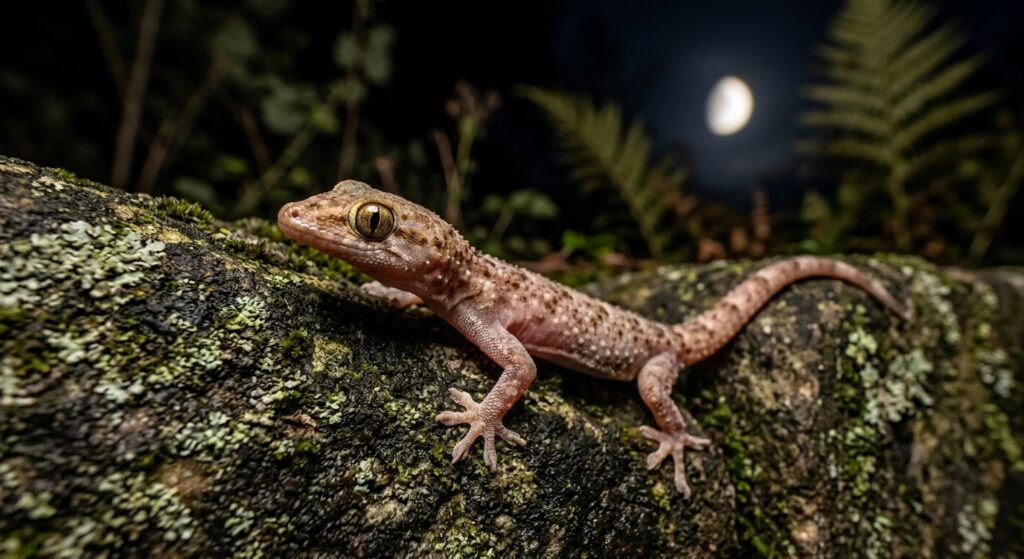
Geckos are a diverse group of lizards found in many parts of the world. Although their habits vary considerably between species, many geckos are nocturnal, emerging after sunset to hunt insects and explore their surroundings.
Their nighttime behavior is particularly interesting because reptiles depend on external sources of heat to regulate their body temperature. For many species, the timing of activity is closely connected to local temperature, humidity, and food availability.
How do geckos see at night?
Many nocturnal geckos have eyes adapted to low-light conditions. Some possess large pupils that allow more light to enter the eye, helping them detect movement and identify potential prey in dim environments.
Certain nocturnal geckos also have impressive color vision under low-light conditions. Their visual systems differ from those of many mammals, demonstrating that night vision does not work in exactly the same way across the animal kingdom.
These adaptations allow geckos to hunt around tree trunks, rocks, walls, and plants where insects may gather.
How does a gecko catch its prey?
A gecko often hunts by remaining still and watching its surroundings. When an insect moves within range, the lizard may quickly turn its head, move forward, and capture the prey with its mouth.
Depending on the species, geckos eat insects such as moths, flies, crickets, and other small invertebrates. Some larger geckos consume a broader range of food.
Many geckos have adhesive toe pads that help them climb vertical surfaces. These pads use microscopic structures to create close contact with surfaces, allowing certain species to move across walls, leaves, and even ceilings.
This climbing ability can help them reach insects that other predators cannot easily access.
Why are nighttime geckos useful in their ecosystems?
Geckos are both predators and prey. By feeding on insects, they contribute to the regulation of insect populations. At the same time, they provide food for birds, snakes, and other predators.
Some geckos also gather near outdoor lights because lights attract insects. Although this behavior can create convenient hunting opportunities, artificial lighting can change natural activity patterns and affect other nocturnal animals.
Not every gecko is nocturnal, and some species are active during daylight. Their habits depend on their evolutionary history and the conditions of their habitat.
Surprising fact: Certain nocturnal geckos can distinguish colors in light levels where humans would struggle to see color clearly. Their eyes are adapted to a nighttime world that looks very different from our own.
-
Firefly: The Insect That Turns Darkness Into a Light Show
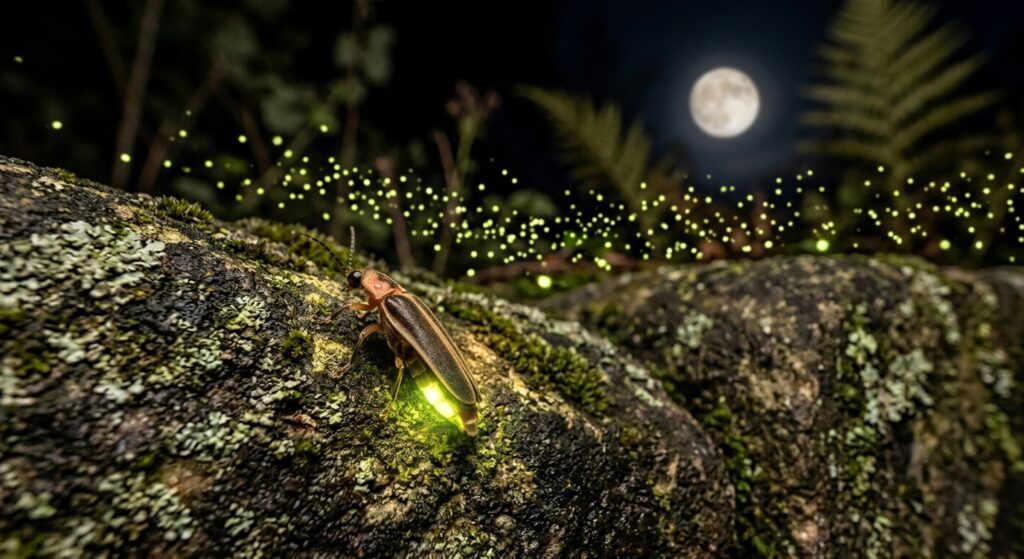
Few nighttime sights are as magical as fireflies glowing in a dark garden or forest. These insects, also known in some regions as lightning bugs, produce light through a biological process called bioluminescence.
Their glowing bodies may look decorative, but the light serves important biological functions. In many species, fireflies use flashing patterns to communicate with potential mates. Their nighttime activity creates one of nature’s most recognizable examples of light-based signaling.
How do fireflies produce light?
Fireflies produce light through a chemical reaction inside specialized light-producing organs, usually located in the abdomen.
The reaction involves a molecule called luciferin, an enzyme called luciferase, oxygen, and other chemical components. When the reaction occurs, energy is released as visible light.
This process is highly efficient compared with many ordinary light sources because relatively little of the energy is lost as heat.
The color and pattern of the glow vary among species. Some fireflies produce brief flashes, while others display more continuous or differently timed signals.
Why do fireflies flash at night?
For many firefly species, flashing is a form of communication associated with reproduction. A flying firefly may produce a particular sequence of flashes, while a potential mate responds with a species-specific pattern.
The timing of these signals helps individuals recognize members of their own species. In some species, the male flies while flashing and the female responds from vegetation. Other species use different signaling arrangements.
This is important because several firefly species may occupy the same general habitat. Distinctive signals help reduce confusion between species.
Not all fireflies use their light in exactly the same way. In some species, light is also associated with warning predators that the insects may be unpalatable or toxic.
Why are fireflies most noticeable in darkness?
The glow is easier to see when surrounding light levels are low. A firefly’s signal may be difficult to notice beneath bright streetlights but strikingly visible in a dark meadow.
Artificial lighting can interfere with the communication of some firefly species, making it harder for individuals to detect one another. Habitat loss, pesticides, and changes to natural environments can also threaten firefly populations.
Protecting dark, vegetated areas can therefore benefit these insects and other wildlife that depend on natural nighttime conditions.
Surprising fact: Firefly light is produced by a chemical reaction inside the insect’s body, and many species use carefully timed flashes as a communication system. What looks like a random sparkle is often a meaningful signal.
-
Aye-Aye: The Lemur That Taps Trees to Find Hidden Food
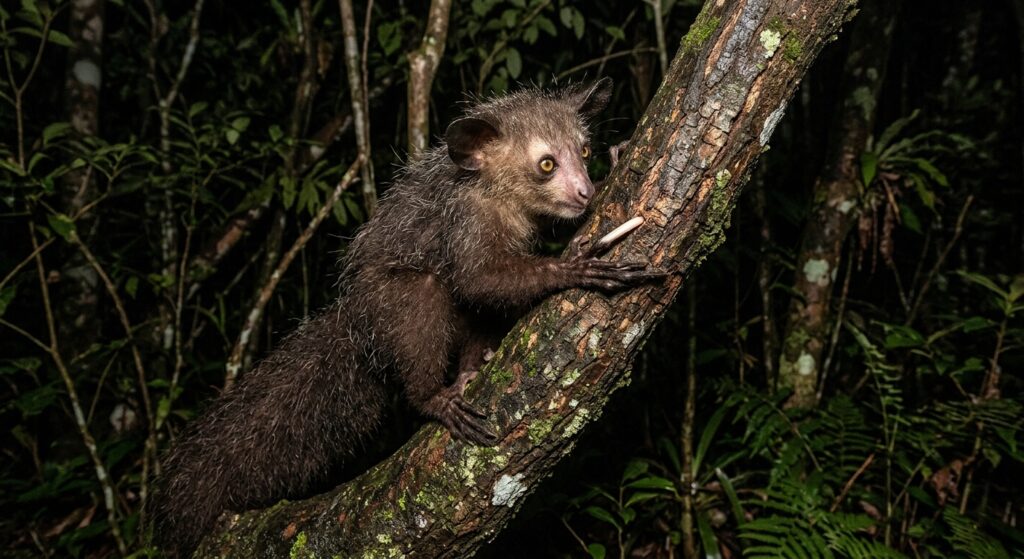
The aye-aye is one of the strangest-looking nocturnal primates in the world. Native to Madagascar, this lemur has large eyes, prominent ears, continuously growing incisors, and an unusually long, thin middle finger.
Its appearance is unusual, but its feeding behavior is even more remarkable. The aye-aye uses a specialized method to locate insect larvae hidden inside wood, combining tapping, listening, biting, and extracting food with its elongated finger.
This technique makes it one of the most distinctive nighttime foragers among primates.
How does the aye-aye find food inside trees?
An aye-aye may move along a branch while tapping the wood with its long middle finger. As it taps, it listens for acoustic clues that could indicate a hollow space or an area containing insect larvae.
When it identifies a promising location, the aye-aye uses its strong incisors to gnaw into the wood. It then inserts its slender finger into the opening and pulls out the hidden prey.
This feeding method is a specialized form of foraging that allows the animal to access food unavailable to many other tree-dwelling animals.
The tapping behavior is not simply random drumming. It is part of a coordinated sequence that helps the aye-aye investigate the structure of the wood and locate potential prey.
Why is its long middle finger so unusual?
The aye-aye’s middle finger is thin and highly mobile, making it well suited to reaching into narrow spaces.
Once the animal opens a small hole in a branch, the finger can help retrieve larvae from inside. Its specialized anatomy is an excellent example of how an animal’s body can evolve in response to a particular feeding strategy.
The aye-aye also eats other foods, including fruit, seeds, and other plant material. Its diet is not limited to insect larvae, although its unusual method of extracting hidden prey is among its best-known behaviors.
Why does the aye-aye live mainly at night?
The aye-aye is nocturnal, spending much of the day resting and becoming active after dark. Nighttime activity is part of its ecological niche, shaping when it searches for food and moves through its forest habitat.
Its large eyes help it function in low light, while its ears and specialized feeding behavior help it investigate its surroundings.
However, nocturnal activity does not make the aye-aye invulnerable. Habitat destruction and human persecution have contributed to conservation concerns for this unusual lemur.
Surprising fact: The aye-aye does not simply search the surface of trees for food. It can tap wood, listen for clues, gnaw an opening, and use its long middle finger to extract prey hidden inside.
Why Do Animals Develop Surprising Night Habits?
The seven animals above use different techniques, but their nighttime routines share several important purposes. Nocturnal behavior has evolved for different reasons across different species, and the benefits of being active after dark depend on an animal’s habitat and lifestyle.
- To avoid extreme daytime heat
In hot environments, the daytime temperature can make activity dangerous or energetically expensive. Some animals avoid the hottest hours by resting in sheltered places and becoming active after sunset.
This is especially important in deserts and other environments where temperatures change dramatically between day and night.
- To hunt when prey is available
Some predators are active at night because their prey is also active during those hours. Owls, for example, hunt many small mammals that move through grass and other habitats after dark.
Matching activity times with prey availability can make hunting more efficient.
- To use senses adapted to darkness
Many nocturnal animals possess specialized sensory abilities. Bats use echolocation, barn owls rely on highly developed hearing, and geckos have visual adaptations that help them operate in dim light.
These abilities allow animals to find food, avoid obstacles, and respond to danger when ordinary human vision would be less useful.
- To reduce competition
Some animals may benefit from searching for food at different times from other species that use similar resources. Nighttime activity can create opportunities to exploit food sources with less competition.
However, this is not a universal explanation. The reasons for nocturnality differ across species, and competition is only one possible influence.
- To communicate and reproduce
Nighttime can also be important for finding mates. Fireflies use light signals, while other nocturnal animals communicate through sounds, scents, or body movements.
These signals help individuals locate one another and, in some cases, recognize members of their own species.